
How Montessori education helps children develop academic knowledge, independence, and essential life skills.
Education during early childhood shapes the foundation for how children learn, think, and interact with the world around them. While traditional schooling often focuses heavily on academic instruction, Montessori education takes a broader approach. It aims to support the development of the whole child by combining intellectual learning with practical life skills, creativity, and social development. Understanding the skills learned in Montessori classrooms is critical to identifying this holistic approach.
The Montessori philosophy, created by Italian educator and physician Maria Montessori, emphasizes hands-on exploration, independence, and individualized learning. Through carefully designed activities and materials, Montessori classrooms encourage children to actively participate in their own education.
At KV Montessori, students engage in various learning experiences that help them build both academic knowledge and essential life skills. Montessori classrooms are designed to nurture curiosity, problem-solving abilities, and confidence while allowing children to progress at their own pace. This environment fosters the skills learned in Montessori classrooms, ensuring a well-rounded development.
Understanding the skills children develop in Montessori classrooms can help parents see how this educational approach supports long-term academic success and personal growth.
Independence and Self-Confidence
One of the most important skills children learn in Montessori classrooms is independence. From an early age, students are encouraged to take responsibility for their work and make choices about their learning activities.
Rather than relying solely on teacher direction, children select materials, complete tasks, and return items to their proper place when finished. This structure helps students build a sense of responsibility and ownership over their learning.
Over time, these experiences foster self-confidence. Children learn that they are capable of solving problems, completing challenges, and learning new skills independently.
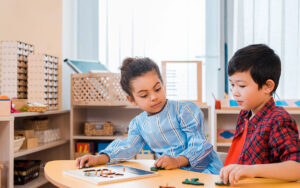
Montessori classrooms are intentionally structured to support this independence. Materials are accessible to children, and the environment encourages exploration without constant adult intervention.
“Montessori education empowers children to become confident learners by giving them the freedom to explore and solve problems independently.”
Critical Thinking and Problem-Solving
Montessori education places strong emphasis on developing critical thinking skills. Instead of memorizing information, children are encouraged to explore concepts, ask questions, and experiment with solutions.
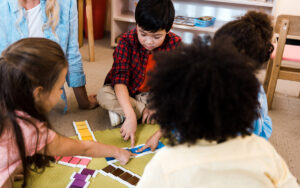
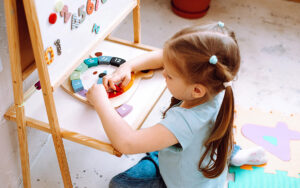
This process heavily relies on hands-on materials. Many Montessori learning tools are designed so that children can discover answers through experimentation rather than being told the solution immediately.
For instance, students can explore mathematical concepts by using counting beads or number rods to physically manipulate quantities. These tools help children visualize patterns and relationships in numbers.
This discovery-based approach encourages deeper understanding and long-term retention of information, which is essential for children to effectively apply mathematical concepts in real-world situations. Children develop the ability to analyze problems, test ideas, and adjust their thinking when necessary.
These problem-solving skills are valuable far beyond the classroom and contribute to lifelong learning.
Academic Skills Across Core Subjects
Montessori classrooms provide strong academic foundations in subjects such as mathematics, language, science, and cultural studies. However, Montessori classrooms often introduce these subjects through interactive and experiential learning instead of traditional lectures.
Language development includes activities such as letter tracing, phonetic awareness, vocabulary building, and early reading exercises. Children gradually progress from recognizing sounds to forming words and eventually reading independently.
Mathematics is introduced using visual and tactile materials that help students understand concepts such as counting, addition, subtraction, and place value.
Science and cultural studies explore topics such as geography, biology, and world cultures. Students learn about their environment, different societies, and natural processes through observation and interactive activities.
Because Montessori classrooms allow students to move at their pace, children often develop strong academic skills while maintaining enthusiasm for learning.
Social and Communication Skills
Montessori education also places strong emphasis on social development. Classrooms often include mixed-age groups, allowing younger children to learn from older peers while giving older students opportunities to demonstrate leadership.
Through collaboration and observation, children naturally develop communication and cooperation skills. They learn to work respectfully alongside others, share resources, and help classmates when appropriate.
Teachers also model respectful communication and encourage children to resolve conflicts peacefully. This helps students develop empathy and emotional awareness.
In Montessori environments, children learn that education is not just an individual experience but also a shared journey where collaboration plays an important role.
“Montessori classrooms foster cooperation and communication by creating a community where children learn from and support one another.”
Practical Life Skills
A distinctive feature of Montessori education is the focus on practical life activities. These tasks help children develop everyday skills that build independence and coordination.
Activities may include pouring water, arranging objects, cleaning workspaces, preparing snacks, or organizing classroom materials. While these tasks may appear simple, they help children develop concentration, motor skills, and responsibility.
Practical life exercises also teach children patience and attention to detail. Completing a task from start to finish encourages persistence and pride in their work.
These experiences reinforce the idea that learning extends beyond academic subjects and includes the development of real-world skills that support daily life.
Creativity and Curiosity
Montessori classrooms encourage creativity and imagination. Rather than limiting learning to rigid lesson plans, children are encouraged to explore their interests and pursue topics that spark curiosity.
Art, music, storytelling, and open-ended activities allow students to express themselves creatively while developing cognitive and emotional skills.
Teachers observe each child’s interests and introduce materials that expand their curiosity. This process helps children develop a lifelong love of learning and discovery.
By nurturing curiosity rather than suppressing it, Montessori education helps children view learning as an exciting and ongoing process.
FAQs
What skills do Montessori students learn?
Montessori students develop academic skills, independence, problem-solving abilities, communication skills, and practical life skills that support personal and intellectual growth.
Do Montessori schools teach traditional subjects?
Yes. Hands-on materials and experiential learning often present subjects like math, language, science, and cultural studies in Montessori classrooms.
How does Montessori support social development?
Mixed-age classrooms encourage collaboration and mentorship, helping children develop communication skills, empathy, and teamwork.
Why are practical life activities important in Montessori education?
Practical life activities help children develop coordination, concentration, independence, and responsibility through everyday tasks.
Conclusion
Montessori classrooms provide children with a well-rounded educational experience that goes beyond traditional academic instruction. By encouraging independence, critical thinking, collaboration, and creativity, Montessori education helps children develop skills that support both academic success and personal growth.
Students develop into confident learners, driven by curiosity and discovery, through the use of hands-on materials, practical life activities, and individualized instruction.
At KV Montessori, educators create supportive learning environments where children can build essential skills while developing a love for learning that lasts a lifetime.
Schedule a tour today to experience how KV Montessori classrooms inspire independence, creativity, and lifelong learning.