
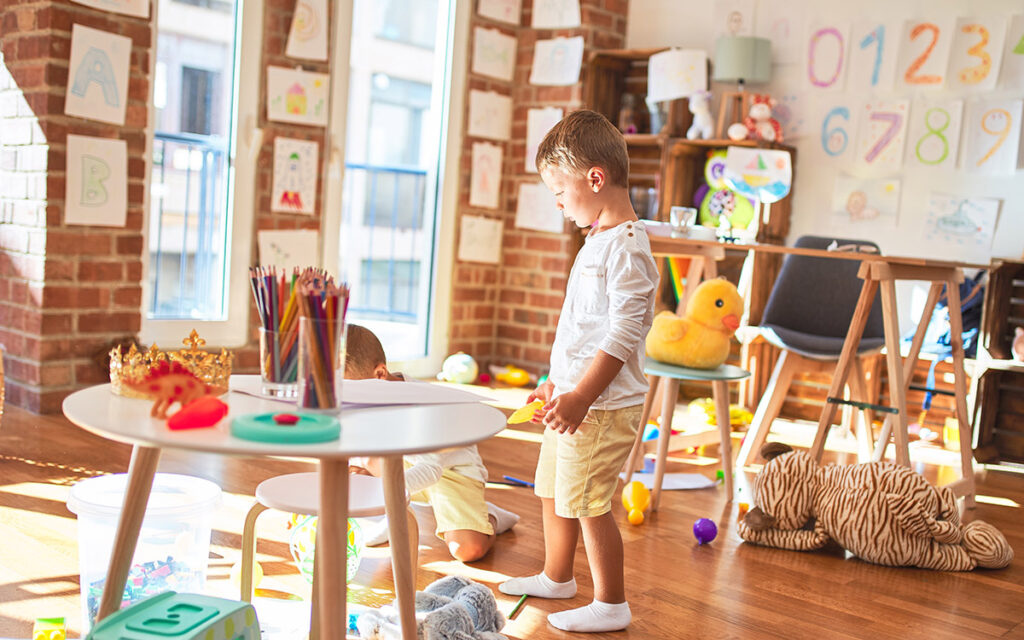
The way purposefully designed Montessori classroom environments change the way children understand, explore, and grow is remarkable.
Parents visiting a Montessori classroom for the first time often notice something unusual.
There is movement, but not chaos.
There is conversation, but not noise.
There is work happening everywhere, yet no single adult directing every child.
The room feels calm, focused, and alive.
At KV Montessori, this atmosphere is not accidental. It reflects a carefully designed approach to learning that respects how children naturally develop, rather than forcing them into a rigid academic structure too early.
Understanding why Montessori classrooms look different helps families see how deeply environment shapes learning.
Learning follows the child, not the clock
In many traditional classrooms, children move from subject to subject according to a fixed schedule.
In Montessori environments, learning follows concentration.
When a child becomes deeply engaged in an activity, that focus is protected instead of interrupted. A lesson may last ten minutes or an hour, depending on the child’s needs and curiosity.
This uninterrupted work time allows children to reach a state of sustained attention that is rare in conventional educational settings.
At KV Montessori, extended work periods give children the freedom to think, repeat, refine, and master concepts at their own pace.
Materials replace worksheets
Rather than learning abstract ideas only through paper and pencil, Montessori classrooms use hands-on materials designed to make concepts visible and tangible.
Children explore quantity by physically moving beads. They understand fractions by holding segmented circles. They build language skills through textured letters and movable alphabets.
These materials allow children to learn through touch and movement as well as sight and sound.
This multisensory approach strengthens memory and comprehension, especially in early childhood when physical experience is closely tied to cognitive growth.
Choice builds responsibility
In Montessori classrooms, children are trusted to choose their own work from a structured set of options.
This does not mean unlimited freedom. The environment is carefully prepared with activities appropriate to each stage of development.
Within that structure, children decide what to work on, where to sit, and how long to engage.
This daily practice of decision-making teaches responsibility in a natural way. Children learn to manage their time, return materials, and respect the learning space.
Rather than relying on constant instruction, they develop internal discipline.
Mixed-age classrooms encourage mentorship
Another visible difference is age grouping.
Montessori classrooms typically include children spanning several years.
Younger students observe older peers completing complex tasks.
Older children reinforce their understanding by helping younger classmates.
This dynamic creates a community rather than a competition.
Children learn patience, empathy, leadership, and cooperation as part of daily life.
At KV Montessori, mixed-age classrooms support social development alongside academics, helping children feel both supported and capable.
Teachers lead instead of commanding.
Montessori teachers are active observers.
They introduce lessons individually or in small groups, then step back to allow independent exploration.
Instead of managing behavior through constant correction, they prepare environments that naturally support order and engagement.
This approach shifts authority from external control to internal motivation.
Children learn to regulate themselves because the environment makes productive choices easier and disruptive behavior unnecessary.
Mistakes are treated as part of learning
In traditional settings, mistakes often bring embarrassment or correction.
In Montessori classrooms, many materials are self-correcting.
Children can see when something does not fit or function as expected and adjust without adult intervention.
This encourages resilience.
Children learn that effort leads to improvement and that mistakes are information, not failure.
A calm classroom supports deep thinking
The physical design of the Montessori classroom contributes directly to learning.
Open shelves allow children to see their options clearly. Natural light reduces sensory overload. Orderly layouts help children feel secure.
This calm environment reduces stress and distraction, allowing attention to remain focused on meaningful work.
At KV Montessori, classrooms are designed to feel welcoming rather than overwhelming.
What parents often notice
Families frequently report that children educated in Montessori settings become more organized, confident, and curious.
They speak about their work with pride.
They complete tasks independently at home.
They show patience and problem-solving skills beyond their years.
These changes reflect the daily practice of responsibility and self-direction in the classroom.
Long-term academic impact
Children who learn in environments that value independence and focus often approach future academic challenges with confidence.
They are comfortable asking questions.
They persist through difficulty.
They see learning as something they actively participate in, not something done to them.
This mindset supports strong performance in later schooling and beyond.
Conclusion
Montessori classrooms are child-centered, not schedule-, textbook-, or adult-friendly.
KV Montessori carefully crafts the learning environment to foster concentration, independence, and genuine understanding.
If you would like to experience how Montessori classrooms support meaningful learning, contact KV Montessori to schedule a tour today. Seeing the environment firsthand often answers questions that words cannot.


