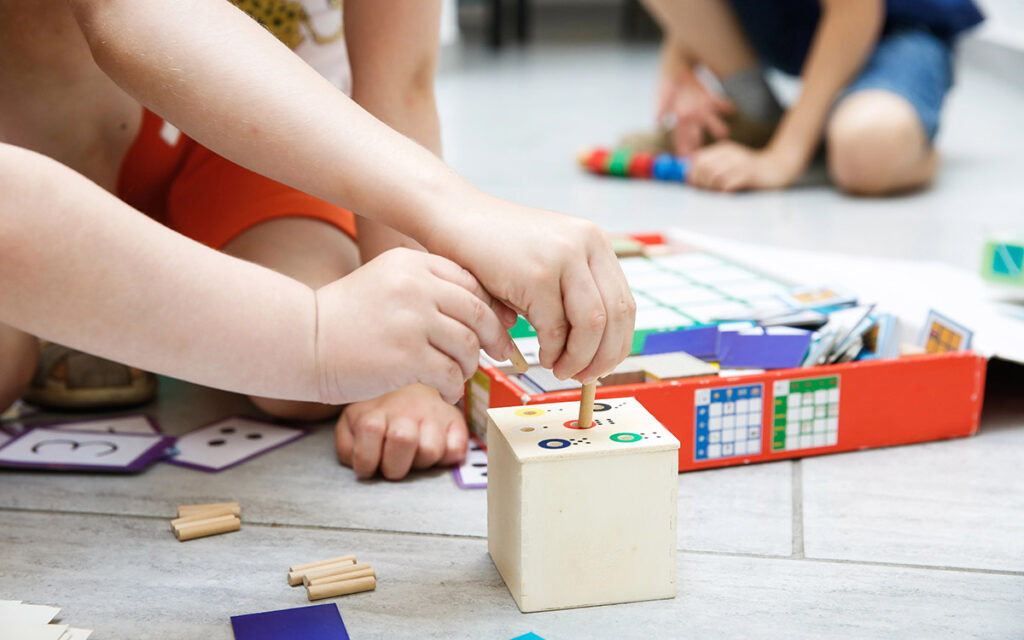
Explore why hands-on learning benefits play a vital role in early childhood development, helping children build confidence, critical thinking, motor skills, and a lifelong love of learning.
Young children learn differently than adults. They are naturally curious, constantly exploring the world through touch, movement, observation, and experimentation. Before children can fully understand abstract concepts, they often need opportunities to physically interact with their environment. This is why early childhood education is most effective when learning goes beyond listening and memorization.
Hands-on learning has become widely recognized as one of the most important approaches to supporting healthy child development. Rather than simply watching or hearing information, children actively participate in the learning process by touching, moving, building, experimenting, and exploring. These experiences help young learners make stronger connections between concepts and real-world understanding.
Understanding the hands-on learning benefits is essential for educators and parents alike, as it promotes a more engaging and effective learning environment.
In Montessori education, hands-on learning is not treated as an occasional activity. It forms the foundation of how children learn. Carefully designed materials and purposeful activities allow children to explore academic concepts independently while also strengthening concentration, confidence, creativity, and problem-solving skills.
At KV Montessori, teachers thoughtfully integrate hands-on learning into everyday classroom experiences to support the development of the whole child. By engaging children through meaningful activities, Montessori education helps create stronger learners while also nurturing curiosity and independence.
“Children learn best when they can touch, explore, and actively experience the world around them.”
Why Early Childhood Is a Critical Time for Learning
The early years of childhood are a period of extraordinary brain development. During this stage, children absorb information rapidly and begin building the cognitive, emotional, social, and physical skills that shape future learning.
Research consistently shows that young children learn most effectively through active experiences. Sitting still for long periods or relying heavily on passive instruction often does not align with how early learners naturally process information.
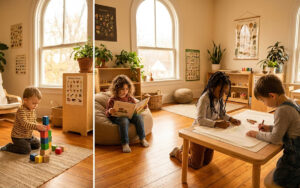
Young children are sensory learners. They understand the world through movement, observation, repetition, touch, and experimentation. Whether stacking blocks, pouring water, tracing letters, sorting shapes, or observing plants grow, every experience contributes to brain development.
Hands-on learning supports this process by transforming abstract ideas into meaningful experiences.
For example, instead of simply hearing about numbers, a child may physically count objects, organize materials by size, or use tactile math tools to understand quantity. Instead of memorizing vocabulary through repetition alone, children may associate language with objects, sounds, or sensory experiences.
These interactions create stronger neural connections and often improve long-term retention because children are actively involved in the learning process.
At KV Montessori, teachers intentionally prepare classrooms to encourage exploration through materials that invite movement, problem-solving, and discovery. Learning becomes something children experience, not something simply delivered to them.
Hands-On Learning Builds Stronger Cognitive Skills
Cognitive development includes how children think, process information, solve problems, and understand relationships between concepts. Hands-on learning helps strengthen these skills because it encourages children to actively engage their minds rather than passively receive information.
When children participate in experiential learning, they naturally begin asking questions, testing ideas, and exploring solutions.
For example, when building a structure with blocks, children are learning much more than just stacking pieces together. They are exploring balance, problem-solving, spatial awareness, and persistence. If the structure falls, they begin experimenting with new approaches.
This trial-and-error process is incredibly valuable.
Children develop critical thinking skills because they are encouraged to analyze situations, make decisions, and adapt strategies independently. Rather than fearing mistakes, they begin understanding that challenges are simply part of learning.
Montessori classrooms are especially effective at encouraging this type of development because many materials intentionally help students self-correct. Instead of relying on adults to constantly point out mistakes, children often recognize and correct errors independently.
This approach encourages:
- Independent thinking
- Problem-solving skills
- Logical reasoning
- Concentration
- Persistence
- Decision-making confidence
For instance, Montessori puzzle maps, counting materials, language activities, and sensory tools all invite children to discover answers through active exploration.
At KV Montessori, teachers carefully observe each child and provide opportunities for meaningful engagement that strengthen thinking skills in age-appropriate ways.
Fine Motor and Physical Development Matter Too
Hands-on learning also plays an important role in physical development, particularly fine motor coordination.
During early childhood, children are still developing control over hand movements, coordination, balance, and body awareness. These skills later support important developmental milestones such as writing, drawing, dressing independently, eating with utensils, and participating in classroom tasks.
Montessori classrooms include many practical life activities specifically designed to strengthen fine motor skills.
Children may practice the following:
- Pouring liquids
- Buttoning clothing
- Using tongs or tweezers
- Cutting safely with child-friendly scissors
- Arranging objects carefully
- Carrying materials responsibly
- Sweeping or cleaning workspaces
While these activities may appear simple to adults, they serve a major developmental purpose.
For example, pouring activities strengthen hand control and concentration, while transferring objects with tongs improves finger strength needed for pencil grip later on. These experiences quietly prepare children for future academic skills while also building confidence and independence.
Movement is also an important component of early learning. Children naturally learn through motion, and Montessori classrooms recognize the value of allowing students to move purposefully throughout the day rather than remaining seated for long periods.
At KV Montessori, hands-on experiences support both physical and academic growth, helping children develop coordination while staying engaged and excited about learning.
“The best learning experiences happen when children are active participants, not passive observers.”
Hands-On Learning Encourages Curiosity and Creativity
Curiosity is one of the strongest drivers of learning during childhood.
Young children naturally want to ask questions, test ideas, and explore how things work. However, traditional educational environments that rely heavily on memorization or uniform instruction may unintentionally limit this curiosity.
Hands-on learning helps preserve and strengthen a child’s natural desire to learn.
When children are encouraged to experiment, observe, and engage directly with materials, learning becomes exciting and meaningful. They begin seeing themselves as explorers rather than simply students waiting for answers.
For example, sensory materials may inspire questions about textures, patterns, or similarities between objects. Science activities may encourage observation and experimentation. Art projects often allow children to express creativity and communicate ideas in unique ways.
Montessori education values this type of self-driven exploration.
Instead of giving children constant instructions, Montessori teachers guide learning by preparing environments that spark curiosity naturally. Children often have opportunities to revisit activities repeatedly, explore personal interests, and move through lessons at their pace.
This process strengthens academic understanding and helps children develop confidence in their ability to think independently.
At KV Montessori, we design classrooms to encourage wonder, exploration, and joyful learning experiences that inspire curiosity from an early age.
Social and Emotional Growth Through Active Learning
Hands-on learning benefits more than academics. It also plays an important role in social and emotional development.
Many hands-on activities encourage collaboration, communication, patience, and problem-solving among peers. Children learn how to share materials, work cooperatively, express ideas, and navigate small challenges together.
These interactions strengthen important social skills that support future success both inside and outside the classroom.
Hands-on experiences also help children build emotional resilience.
Because Montessori activities often encourage repetition and independent problem-solving, children gradually learn that mistakes are normal. Instead of becoming discouraged, they begin practicing persistence and patience.
This mindset can positively influence self-esteem and emotional confidence.
Children often feel proud when they successfully complete meaningful tasks on their own, whether tying shoes, finishing a classroom activity, or solving a problem independently.
At KV Montessori, emotional growth is viewed as equally important as academics. Hands-on learning experiences are intentionally designed to support confidence, independence, and positive social interaction.
Why Montessori Education Prioritizes Experiential Learning
Montessori education is built on the understanding that children learn best through experience.
Rather than separating learning from action, Montessori classrooms integrate movement, exploration, and hands-on materials into nearly every subject area. Math becomes visual and tactile. Language becomes interactive. Science becomes observational and experiential.
This learning style often helps children develop more profound understanding because they are not simply memorizing information for short-term success. They are building meaningful connections through active participation.
Montessori education also respects that every child learns differently. Some children absorb information visually and others through touch or movement. Hands-on learning allows multiple learning styles to be supported naturally.
At KV Montessori, experiential learning helps children feel engaged, capable, and excited about discovering new ideas every day.
Frequently Asked Questions
What is hands-on learning in early childhood education?
Hands-on learning involves children actively participating in activities through touch, movement, problem-solving, and exploration rather than only listening or observing.
Why is hands-on learning important for preschoolers?
Hands-on learning supports brain development, strengthens fine motor skills, improves concentration, encourages curiosity, and helps children retain information more effectively.
How does Montessori use hands-on learning?
Montessori classrooms use specially designed learning materials that allow children to explore concepts independently through tactile, interactive experiences.
Can hands-on learning improve confidence?
Yes. When children successfully complete activities independently, solve problems, and explore concepts through action, they often develop stronger self-confidence and independence.
Support Your Child’s Growth Through Hands-On Learning at KV Montessori
The early years offer opportunities for discovery, growth, and meaningful learning experiences. Children thrive when education encourages movement, curiosity, creativity, and active participation.
At KV Montessori, hands-on learning helps children build confidence, critical thinking skills, independence, and a lifelong love of learning. Through carefully designed Montessori experiences, we support children academically, socially, and emotionally in ways that help them reach their full potential.
If you are looking for an early learning environment where your child can learn by doing, exploring, and growing with confidence, KV Montessori is here to help guide the journey.