Research on bilingual education for toddlers is reassuring. Learning two languages at once does not cause language disorders or delays, and children in strong dual-language programs generally keep pace in English. Some claimed benefits, like a broad thinking-skills advantage, are weaker than the headlines suggest. Exposure and quality matter most.
Key Takeaways:
- Learning two languages does not cause speech or language disorders, according to pediatric and speech-language guidance.
- Compare a bilingual toddler’s vocabulary across both languages combined, not one language alone.
- Most children sort their two languages out by around age three; mixing before that is normal.
- Evidence for a general “bilingual brain boost” is weaker than popular claims suggest.
- How much language a child hears, and how rich it is, drives development more than the number of languages.
You have heard both versions. One says bilingual education for toddlers builds a sharper brain and a lifelong advantage. The other says two languages will confuse a two-year-old and set back her speech. Neither is quite right, and the actual research is more useful than either.
Toddlerhood is when families usually decide. Between 18 and 36 months, language arrives quickly, and parents want to know whether adding a second one helps, hurts, or does nothing at all.
This article walks through what the evidence supports, what it does not, and what bilingual learning looks like in a real toddler classroom in Chula Vista. It is general information rather than advice for your individual child, and a pediatrician or speech-language pathologist is the right person to ask about a specific concern.
In short, the fears are not supported by the research, and neither are the biggest promises. What remains is a solid, ordinary case for starting early, which is usually enough to make the decision.
Is Bilingual Education for Toddlers a Reasonable Idea?
For most toddlers, yes, and at minimum it is harmless. The American Speech-Language-Hearing Association states plainly that teaching a child two languages will not confuse the child or cause or worsen speech or language problems. Bilingual children reach language milestones on a normal timeline.
The benefits worth counting are the concrete ones: access to two languages, connection to family and community, and strong programs and literacy advantages that show up later in school.
The caveat is that quality varies enormously. A program that exposes children to a second language for twenty minutes a week is not the same as one where the language is part of the day.
How Toddlers Learn Two Languages at Once
Very young children learn language by using it, not by studying it. A toddler in a bilingual room is not translating. She is learning that certain sounds go with certain actions, objects, and people.
Two pieces of guidance help parents read their child’s progress correctly. First, the American Academy of Pediatrics notes through HealthyChildren.org that a bilingual child’s total vocabulary across both languages should be comparable to a monolingual peer’s single-language vocabulary and that children generally separate their languages by about age three.
Second, mixing languages in one sentence is normal. ASHA describes it as a typical part of using more than one language, and research on families finds that parents themselves switch between languages in systematic, purposeful ways when speaking to bilingual infants. Children are copying a real pattern, not losing track.
Count your toddler’s words across both languages. That is the fair comparison.
What the Research Shows
Language and early literacy
Early dual-language programs have produced encouraging results. A NIEER study of two-way immersion preschool found gains in Spanish for native Spanish speakers with no cost to English learning. Further out, RAND’s evaluation of Portland’s immersion program found immersion students ahead in reading by about seven months in fifth grade.
Thinking skills, where evidence is mixed
This area is where popular claims outrun the data. A large meta-analysis of bilingualism and executive function, covering more than 23,000 children, found a very small advantage that essentially disappeared after correcting for publication bias. Some studies suggest benefits; the overall picture is weak. It is a reason not to worry, but not a reason to enroll.
Home language and family connection
Keeping the home language strong has value of its own. The National Academies’ review of educating English learners concluded that strong first-language literacy and vocabulary support learning a second and even third language. For families where grandparents speak Spanish, that connection is not a side benefit.
What Bilingual Education Cannot Promise
No program can promise that your child will be fluent, or smarter, or ahead. What drives bilingual development is exposure: research on young bilinguals has found that measures of vocabulary and grammar in each language track the relative amount of input a child receives in that language.
In practical terms, a child who hears Spanish a few hours a week will understand more than she produces, and that is a real outcome worth having. Fluency usually requires more.
This is worth saying plainly because marketing in this space often lacks clarity. A few hours a week of a second language gives a child a foundation: familiarity with the sounds, a working set of words, and comfort with the idea that people speak in more than one way. It does not make a two-year-old bilingual by spring.
It is also normal for one language to be ahead of the other at any given moment, and for that balance to shift when family routines or schools change.
What Bilingual Education for Toddlers Looks Like in a Montessori Classroom
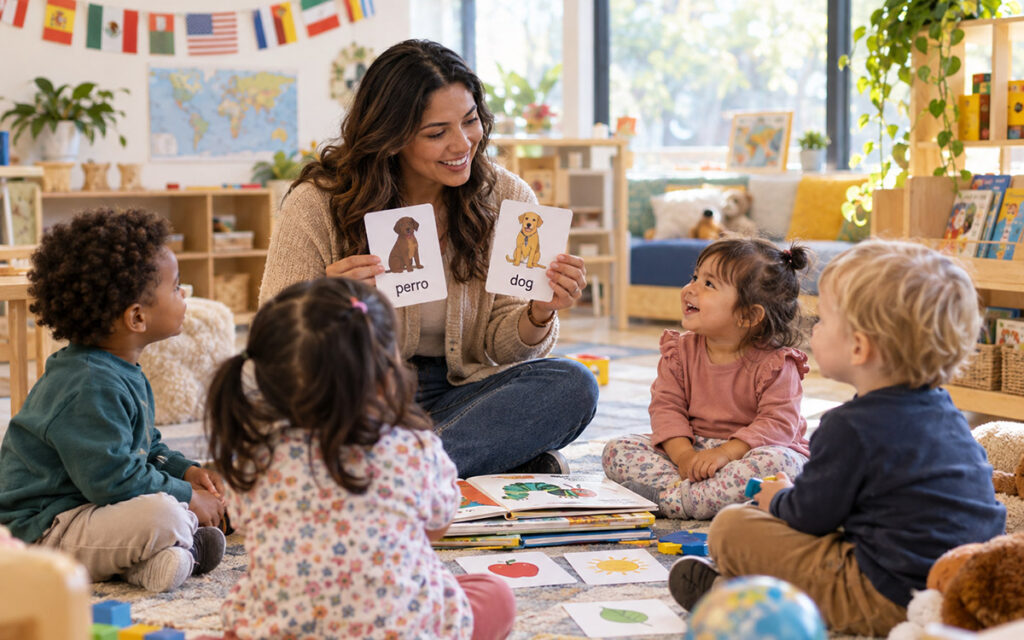
In a Montessori toddler room, language is attached to activity. Children pour, carry, wipe, and sort, and the words come with the work. That repetition, in context, is precisely what a young language learner needs.
The Toddler program at KV Montessori Academy serves children 18 to 36 months with practical life exercises, sensory exploration, and vocabulary building in a school that describes itself as bilingual and integrates daily Spanish lessons into its program. Toilet training is not required for enrollment and is supported as part of the program, which is relevant for families considering an early start.
Mixed-age grouping helps as well. Younger toddlers hear older children using language slightly beyond their level, all day, without anyone calling it a lesson.
Toddler classrooms also run on routine, which is a gift for language learning. The same handful of phrases come around at the same moments every day: arrival, handwashing, snack, cleanup, and goodbye. Repetition in a predictable context is how a small child builds meaning.
What you will not see is drilling or flashcards. A toddler’s job is to move, touch, and repeat, and the language rides along with the activity.
Simple Ways to Support It at Home
- Speak the language you speak best, and speak a lot of it
- Read aloud daily, in either language
- Sing, since songs carry vocabulary and rhythm together
- Let mixing happen without correcting it
- Talk with your pediatrician if you have concerns about speech, rather than waiting
- Keep it playful, since pressure to perform tends to make young children go quiet
If relatives speak another language, give them time with your child. A grandparent who speaks only Spanish is a better language resource than any app, because the conversation has a reason to happen.
Frequently Asked Questions
Will learning two languages delay my toddler’s speech?
Pediatric and speech-language guidance says no: bilingualism does not cause speech or language disorders or delays. Bilingual children reach milestones on a typical timeline. If your child’s development concerns you, talk to your pediatrician, since a delay would have a cause unrelated to bilingualism.
Why does my toddler mix Spanish and English in one sentence?
Mixing, or code-switching, is normal and expected. Children hear adults do it, and it reflects using two vocabularies flexibly rather than confusing them. Most children clearly separate their languages by around age three.
Does my toddler need to hear only one language per parent?
No. One-parent-one-language is a popular approach, but it is not a requirement. What matters more is the overall amount and richness of the language your child hears in each language.
Is my toddler’s vocabulary behind if she knows fewer English words?
Not necessarily. Compare her total vocabulary across both languages rather than English alone. Bilingual children often distribute words between languages depending on where they use each one.
When is the right age to start a bilingual program?
There is no single right age. Starting in toddlerhood means more years of exposure, which generally helps, but children also learn a second language successfully later. The better question is how much language a program provides and whether your child is comfortable there.
Curious what a bilingual Montessori day actually looks like for a toddler? Come see it in person. KV Montessori Academy welcomes families in Eastlake and Chula Vista to tour our classrooms and meet our teachers, including our toddler program for children 18 to 36 months.
Schedule a Tour or call (619) 730-4020.
Every child develops at their own pace, and this article is general educational information rather than medical advice or a guarantee of specific outcomes. If you have concerns about your child’s speech or language development, speak with your pediatrician. You can also read more about our approach to bilingual learning or about our school.