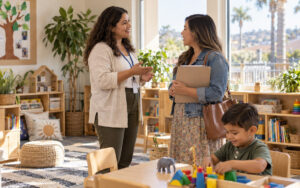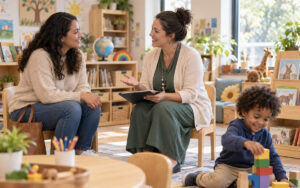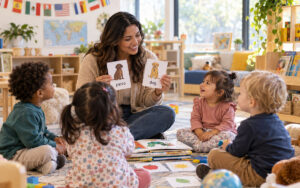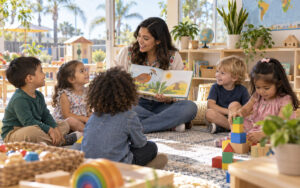
A bilingual preschool in Chula Vista teaches a second language through everyday use rather than language drills. Children hear and use Spanish during routines, songs, and hands-on work, which is how young children learn language naturally. This guide explains immersion models, what bilingual learning looks like in a Montessori classroom, and what to ask on a tour.
Key Takeaways:
- Immersion means children use the language during real activities, not in a separate lesson block.
- Programs vary widely, from a daily Spanish lesson to full-day instruction in the target language.
- More than half of Chula Vista residents age five and older speak a language other than English at home.
- Young children can learn two languages at once without one crowding out the other.
- Ask any school how much Spanish children hear daily and how both language backgrounds are supported.
If you are looking at a bilingual preschool in Chula Vista, you have probably noticed that “bilingual” means entirely unique things at different schools. One program runs a 20-minute Spanish lesson twice a week. Another teaches half the day in Spanish. Both use the same word on their website.
That matters, because how a program delivers the language shapes what your child actually picks up. It also shapes the questions worth asking on a tour, which are more specific than “do you teach Spanish?”
Chula Vista is a natural place for this conversation. Census figures show that 57.4% of Chula Vista residents age five and older speak a language other than English at home.
For many local families, a bilingual classroom is not an enrichment add-on; it is continuity with home. For others, it is the start of something new. This guide is written for both, and it covers how immersion works, what it looks like day to day in a Montessori classroom, and what the research supports.
What Is a Bilingual Preschool in Chula Vista?
A bilingual preschool is one where children regularly hear and use two languages during the school day. The label covers a wide range, from schools with a daily Spanish component to full dual-language programs where a large share of instruction happens in Spanish.
The distinction that matters is exposure: how much of the day is in the second language and whether children use it for real purposes or only practice it.
California has been building toward more of these programs. The state’s Global California 2030 initiative set a goal of having half of all K-12 students enrolled in programs leading to proficiency in two or more languages by 2030, and the number of dual-immersion programs statewide has grown substantially. Early childhood is where many families start.
How Language Immersion Works
Immersion means the second language is the medium, not the subject. Instead of a class about Spanish, children hear Spanish while they wash a table, sing a song, set out a snack, or listen to a story, and they respond in context.
The Center for Applied Linguistics describes several models: total immersion, where nearly all instruction happens in the target language, and partial immersion, where roughly half does, along with two-way programs that intentionally mix native speakers of both languages in one classroom.
Preschool immersion looks less formal than any of those descriptions suggest. A three-year-old is not conjugating verbs. She is learning that this word means “please pass it,” because that is what causes the bowl to be the bowl passed.
That also explains why exposure time matters so much. A child who hears Spanish only during a scheduled lesson gets a handful of opportunities each week. A child who hears it during snack, cleanup, songs, and greetings gets dozens of opportunities a day, in situations where the meaning is clear from context.
It is normal for children to understand far more than they say at first. Comprehension comes before speech in any language, so a quiet child may be absorbing a great deal.
In immersion, language is the medium, not the subject. Children use it to get something done.
What Bilingual Learning Looks Like in a Montessori Classroom
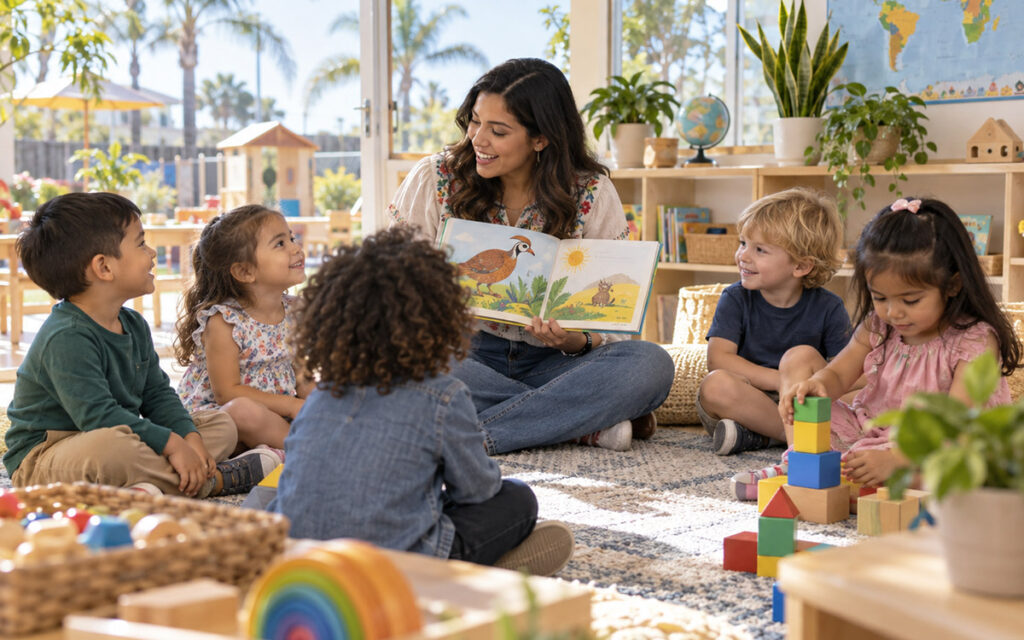
Montessori classrooms lend themselves to this approach because so much of the day is hands-on and repeated. “Practical life,” the Montessori term for everyday activities like pouring, sweeping, and buttoning, gives children the same vocabulary many times in a real context.
Spanish woven into daily routines
Greetings, transitions, songs, and mealtime language come around every single day. Repetition in context is what makes vocabulary stick at this age, more than any worksheet can.
Vocabulary through hands-on materials
Montessori materials are concrete, which makes them easy to name in either language. A child holding a rough and smooth board is learning two words for a sensation she can feel.
Mixed-age classrooms
Montessori groups children across a three-year age span, so younger children hear older ones using language they have not learned yet. At KV Montessori Academy, the programs run from Toddler (18 to 36 months) through Primary Advanced (3.5 to 6 years), and the school integrates daily Spanish lessons into its program as a bilingual preschool.
What Research Says About Early Bilingual Programs
Research on preschool dual-language programs is encouraging, with a caution: results depend on program quality and how much of the language children actually hear.
A NIEER study of two-way immersion preschool found that Spanish-speaking children made strong gains in their home language without losing ground in English. Longer term, a RAND evaluation of Portland’s dual-language immersion program found that immersion students were about seven months ahead in reading by fifth grade and nine months ahead by eighth grade, compared with peers.
Those are specific programs in specific places, not promises about any individual child. They do suggest that starting early does not cost children anything academically, which is the worry many parents arrive with.
Supporting Two Languages at Home
Families often ask whether they need to change how they speak at home. The short answer is no, and there is no single correct arrangement.
The American Academy of Pediatrics addresses this directly through HealthyChildren.org, noting that a bilingual child’s total vocabulary across both languages is the right comparison to a monolingual peer, and that children typically sort their languages out by around age three.
What helps most is simply more language: talking, reading, and singing in whichever language you speak most comfortably. A parent speaking rich, natural Spanish at home does more for a child than a parent speaking careful, limited English.
Questions to Ask a Bilingual Preschool in Chula Vista
Bring these to your tour, and listen for specifics rather than philosophy:
- How much of the day do children hear Spanish, and during which activities?
- Who speaks Spanish with the children, and how consistently?
- How do you support a child who arrives speaking only English? Only Spanish?
- What does a bilingual day look like for the youngest children versus the oldest?
- How do you share progress with families?
You will learn more from watching ten minutes of a classroom than from any answer. Ask to see the room during a normal work period, not at pickup.
Watch for whether Spanish is being used for real purposes: giving directions, describing work, singing, or solving a small problem between two children. If the only Spanish you hear during a visit is a counting song performed for the guests, that tells you something too.
Frequently Asked Questions
What does “bilingual preschool” actually mean?
It varies by school. Some programs offer a short daily Spanish lesson, others teach a substantial portion of the day in Spanish, and two-way programs deliberately mix native speakers of both languages. Ask each school how much of the day happens in the second language and in what kinds of activities.
Is my child too young to start a second language?
Toddlers and preschoolers learn language through daily use, and starting early provides more years of exposure. Every child moves at a different pace, and there is no single window that closes. The important factors are consistent exposure and language that is meaningful to the child.
Will learning Spanish slow down my child’s English?
Research on early dual-language programs generally does not find English losses, and pediatric guidance treats bilingual development as a normal path. Children may know some words in one language and not the other for a time, which is why total vocabulary across both languages is the fair comparison.
What if we only speak English at home?
That is common, and children in immersion programs regularly come from monolingual homes. Support your child by reading and talking in the language you speak best, and let the school provide the Spanish exposure.
Does KV Montessori offer bilingual instruction for toddlers?
KV Montessori Academy describes itself as a bilingual preschool and integrates daily Spanish lessons into its program, with classes beginning at 18 months in the toddler group. You should ask directly how much Spanish each age group hears, and you can best see it in person on a tour.
Curious what a Montessori day actually looks like for your child? Come see it in person. KV Montessori Academy welcomes families in Eastlake and Chula Vista to tour our classrooms at 851 District Place and meet our teachers. Watching a bilingual classroom during a normal work period tells you more than any brochure can.
Schedule a Tour or call (619) 730-4020.