Starting Montessori school is a big transition, and some tears at drop-off are completely normal, not a warning sign. During the first weeks at Montessori school, teachers focus on quiet observation, building trust, and helping your child learn the classroom’s rhythm before introducing new work. Most children start feeling comfortable within two to six weeks, and staying close with your child’s teacher makes the whole process easier to track.
Key Takeaways
- Tears at drop-off are normal and are not a sign of a bad fit between your child and the school.
- Teachers spend the first weeks mostly observing your child, not jumping straight into new lessons.
- Most children settle into a Montessori classroom somewhere between two and six weeks.
- Short, calm, and consistent goodbyes help your child adjust faster than long farewells.
- Checking in with your child’s teacher regularly helps you see real progress you might miss at drop-off.
What Really Happens During Your Child’s First Weeks at Montessori School
In the first days and weeks, teachers are not focused on academics at all. Their priority is helping your child feel safe, learn where things belong, and trust the adults in the room. This grounding period matters more than any lesson, and it’s a core piece of what the American Montessori Society describes as the essential building blocks of a Montessori classroom.
A Montessori classroom is often called a “prepared environment,” meaning every shelf, material, and routine is arranged specifically to help children work independently once they’re ready. During the first weeks, your child is simply getting oriented to that environment: where to hang a coat, how to choose an activity, and when snack happens. Age-specific programs, like the curriculum at KV Montessori Academy, build this slow orientation into their design from day one.
Expect your child to watch other children more than they participate at first. That’s normal and expected, not a sign they’re behind.
Why Crying at Drop-Off Doesn’t Mean Something Is Wrong
Tears at drop-off are one of the most common and normal parts of starting school, and they usually reflect a healthy attachment rather than a problem with the classroom. Separation anxiety typically peaks in the early weeks of a new routine and fades as your child learns that you always come back. It is not a sign that something is wrong with your child or the school.
Pediatric guidance from the American Academy of Pediatrics on soothing separation anxiety points to one consistent strategy: keep goodbyes brief, warm, and confident. Lingering, sneaking away, or repeatedly checking on your child from the doorway tends to prolong the distress rather than ease it.
Crying at drop-off is often a sign of a loving bond, not a sign something is wrong.
Zero to Three’s research on separation anxiety notes that toddlers in particular may protest loudly one day and walk in happily the next, sometimes within the same week. That inconsistency is developmentally normal. Your child’s teacher will let you know if crying continues well past the settling-in window or seems different from typical separation distress.
The Montessori Observation Period: What Teachers Are Really Doing
During the first weeks, teachers spend much of their time in quiet observation rather than direct teaching. This is sometimes called the observation period, a time when the teacher watches how a child moves, communicates, and responds to the environment before introducing new lessons. It is a deliberate, purposeful part of Montessori training, not a sign that your child is being ignored.
The Association Montessori Internationale describes this approach as “see, support, share,” where teachers first notice what a child is ready for before stepping in. Careful observation lets a teacher offer the right material at the right moment instead of pushing a lesson before a child is emotionally settled.
You can read more about how our teachers are trained to observe and guide children on our about us page. This philosophy is central to how every classroom, from toddler to primary, operates.
How Long Do the First Weeks at Montessori School Adjustment Usually Take?
Most children begin to feel comfortable in a new Montessori classroom somewhere between two and six weeks, though the exact timeline depends on the child’s age, temperament, and past experience with separation. Toddlers new to any group care setting often need the full range, while children who have attended daycare or preschool before may settle in closer to two weeks.
A younger toddler transitioning for the first time may need daily reassurance for several weeks. A three- or four-year-old with previous classroom experience may settle in within days. Both timelines are completely normal, and neither one predicts how happy your child will ultimately be at school.
Try not to compare your child’s pace to another family’s story. Every child’s nervous system adjusts to new routines differently, and rushing the process rarely helps.
What You Can Do at Home to Support the Transition
A few consistent habits at home can make the first weeks noticeably smoother. NAEYC’s guidance on starting preschool recommends keeping mornings predictable, from wake-up time through the walk into the classroom, so your child knows what comes next.
Build a short goodbye ritual, like a specific hug, wave, or phrase, and use it every single day. NAEYC’s advice on easing first-day jitters also points out that a calm, confident parent tends to produce a calmer child, even when the child protests at the door.
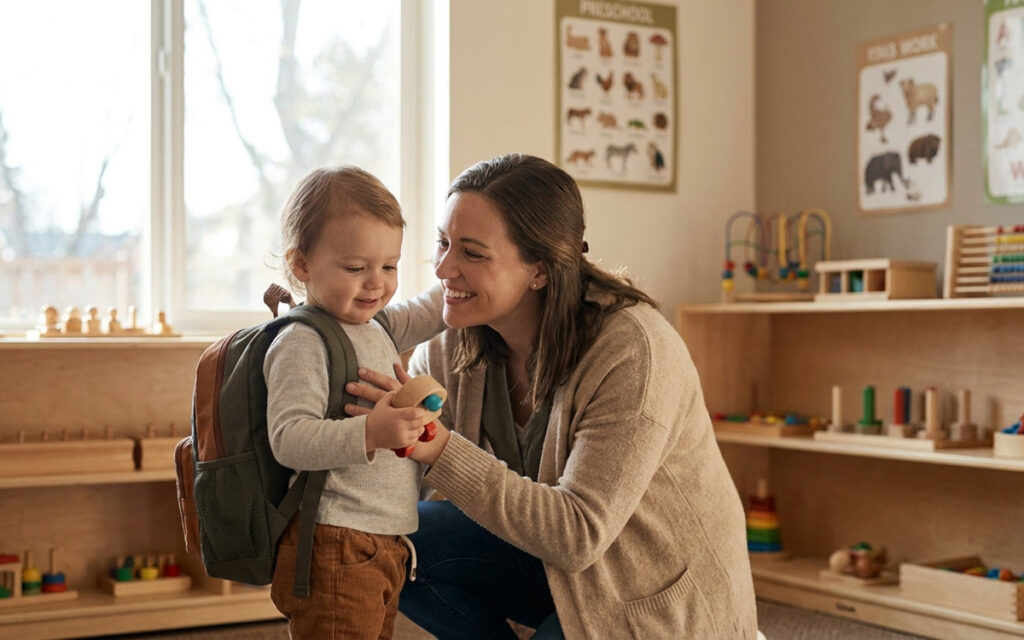
Keep goodbyes brief. A drawn-out farewell, however well-intentioned, usually signals to your child that there is something to worry about. Trust your child’s teacher to handle things from there once you’ve said goodbye.
Finally, stay in contact with your child’s teacher. A quick conversation at pickup about how the day actually went, separate from how drop-off felt, gives you a much clearer picture of your child’s progress.
Signs Your Child Is Settling In
Progress in the first weeks rarely looks dramatic. Instead, watch for small, steady signs that your child is finding their footing in the classroom.
A child who is settling in will often start choosing an activity on their own instead of waiting to be guided to one. They may come home mentioning a classmate’s name or a teacher for the first time, which is usually a strong sign a real connection has formed. Clinginess at drop-off tends to shorten too, even if it doesn’t disappear completely right away.
Sleep and appetite at home can also offer clues. Many children are simply tired from the effort of a new routine, and that usually eases as the classroom becomes familiar.
How KV Montessori Academy Supports New Families in Eastlake and Chula Vista
At KV Montessori Academy, we never leave new families to figure things out alone. Our teachers keep classroom groupings small and age-based, from Toddler through Primary Advanced, so every child gets consistent, personal attention during the settling-in period.
Spanish is woven into the daily rhythm from day one, not taught as a separate subject, so bilingual learning becomes part of the same comfortable routine your child is already adjusting to. Families throughout Eastlake, Otay Ranch, and the greater Chula Vista area choose our program specifically for that dual-language foundation alongside the Montessori approach.
If you’re weighing your options, we’d love to have you visit before you decide. Seeing an actual classroom in session, with children making their own choices and moving at their own pace, gives you a clearer sense of what to expect than any brochure. You can also browse our blog for more first-hand guidance on what to expect as your family settles in.
A Brief Closing Thought
Starting school is an adjustment for the whole family, not just your child. The early weeks can feel uncertain, but they’re also where trust between your child, their teacher, and the classroom itself gets built, one ordinary day at a time.
Curious what a Montessori day actually looks like for your child? Come see it in person. KV Montessori Academy welcomes families in Eastlake and Chula Vista to tour our classrooms and meet our teachers. Schedule a Tour or call (619) 730-4020.
Every child develops at their own pace, and the timelines described here are general educational information rather than a guarantee of how any specific child will adjust.
Frequently Asked Questions
How long does it take for a toddler to adjust to a Montessori classroom? Most toddlers take somewhere between two and six weeks to feel comfortable in a new Montessori classroom. Children who are newer to group care or separation in general may need the longer end of that range, while children with prior daycare or preschool experience often adjust faster. The pace depends on the individual child, not on how well the school is working.
Is it normal for my child to cry every day at drop-off, even after the first week? Yes, this is common and does not necessarily mean something is wrong. Some children take longer than others to move past separation anxiety, especially toddlers experiencing a new routine for the first time. If crying continues well beyond the first month or seems to intensify rather than ease, it’s worth checking in with your child’s teacher to talk through what they’re observing during the day.
What should I do if my child clings to me at drop-off? Keep your goodbye short, warm, and consistent, using the same brief ritual each day. Lingering or repeatedly returning to check on your child tends to make the moment harder for both of you. Trust your child’s teacher to help your child settle once you’ve said goodbye, and check in at pickup to hear how the rest of the day actually went.
Will my child fall behind if they cry or seem unsettled during the first few weeks? No. Early emotional adjustment and academic readiness are separate processes, and a rocky start at drop-off does not predict how a child will do in the classroom over time. Teachers use the early weeks specifically to observe each child before introducing new lessons, so there is no lesson your child is “missing” while they settle in.
How is KV Montessori Academy different for a new bilingual family? Spanish is integrated into daily classroom life from day one rather than taught as a separate lesson, so bilingual families see language learning happen naturally alongside the same settling-in process every new student goes through. Small, age-based groupings also mean your child gets consistent attention from familiar teachers during those first important weeks. Families in Eastlake and Chula Vista are welcome to schedule a tour to see this in person.