Montessori classrooms teach abstract ideas, like numbers, quantity, and the decimal system, by starting with something a child can touch. Montessori materials such as the Pink Tower, Number Rods, and Golden Beads let a child feel a concept in her hands before she holds it in her mind. In KV Montessori Academy’s Primary Advanced classroom (ages 3.5 to 6), this concrete-to-abstract path builds real, lasting number sense.
If you have ever watched a young child stack blocks by size or count with their fingers, you have watched the beginning of abstract thinking. Montessori materials are built around that exact instinct. Rather than asking a three- or four-year-old to understand what “ten” means from a worksheet, a Montessori classroom hands her ten actual beads to hold, sort, and carry across the room.
That difference, between telling a child about an idea and letting her build it herself, is at the heart of how Montessori education approaches math, language, and reasoning. Below, we walk through what “concrete to abstract” really means, which materials do the heavy lifting, and how this plays out day to day in a Primary Advanced classroom.
What “Concrete to Abstract” Actually Means in Montessori Materials
In Montessori terms, “concrete to abstract” means a child first experiences an idea physically, through an object she can see and touch, before she is asked to think about that same idea in her head. Montessori materials are sometimes called “materialized abstractions,” a term used by the Association Montessori Internationale because they take an invisible concept, like size, weight, or quantity, and turn it into something a small hand can pick up.
A worksheet asks a child to imagine that the numeral “5” represents five of something. A Montessori material simply gives her five things to count, stack, or line up. The abstraction (the number 5 as an idea) comes later, built on top of that real, physical experience.
This is not a shortcut around abstract thinking. It is the foundation for this. Children who have physically sorted, measured, and compared objects have something real to draw on when they are later asked to reason about numbers or ideas they cannot touch.
Sensorial Materials: Training the Senses Before the Mind
Before children work with number materials, Montessori classrooms use what are called sensorial materials: hands-on tools designed to sharpen a child’s ability to see, hear, and feel differences in size, weight, texture, and sound. The Pink Tower, Red Rods, and Sound Cylinders are classic examples, each isolating one quality, like size or pitch, so a child can focus on comparing it precisely.
The Pink Tower is a set of ten pink wooden cubes, from a tiny one-centimeter cube up to a ten-centimeter cube. A child builds the tower from largest to smallest, using nothing but her eyes and hands to judge size. As the American Montessori Society notes, work with sensorial materials like these refines a child’s senses and lays groundwork for later academic skills, including math and writing.
Many of these materials include a built-in “control of error,” meaning the material itself shows the child when something does not fit or line up correctly, without a teacher needing to step in and correct her. A cylinder that will not sit flush in its socket, or a tower that looks lopsided, tells the child something is off. That quiet feedback loop builds independence and confidence at the same time.
Before a child can hold a number in her mind, she needs to hold it in her hand.
From Number Rods to Golden Beads: A Hands-On Math Journey
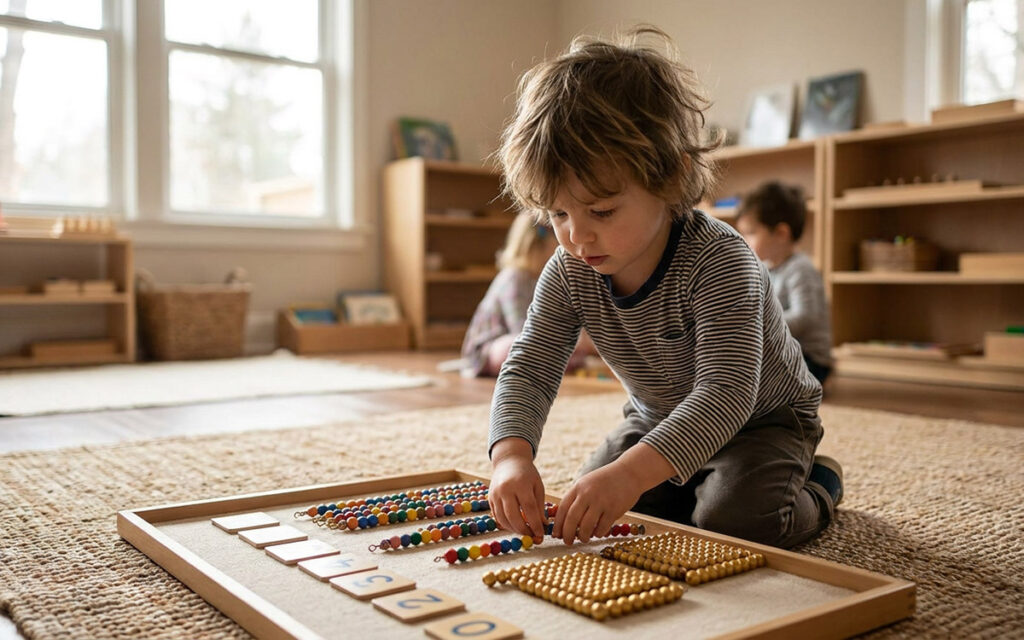
Montessori math builds in a deliberate sequence, and it typically starts with the Number Rods: a set of ten rods, each one unit longer than the last, that let a child physically feel the difference between the quantities one through ten. According to the Association Montessori Internationale, a child first counts and compares the rods themselves, then connects each length to its written numeral, so quantity and symbol are learned together rather than as separate facts to memorize.
From there, children move through materials like the Spindle Boxes and Sandpaper Numerals, which continue linking quantity to written symbols, and eventually to the Golden Beads, one of the most recognizable Montessori math materials.
The Golden Beads represent the decimal system in physical form: a single bead is one unit, a bar of ten beads is a “ten,” a flat square of one hundred beads is a “hundred,” and a cube of one thousand beads is a “thousand.” A child can hold a thousand in her hands, compare it to a single unit bead, and see the relationship instantly. That concrete experience of place value becomes the foundation she later draws on when working with numbers entirely in her head.
This sequence is not rushed. Each material is introduced only when a child is ready, and each one builds directly on the understanding created by the previous one.
Why Hands-On Learning with Montessori Materials Works
Research on early math learning backs up what Montessori classrooms have practiced for over a century: children build a stronger number sense when they can manipulate physical objects while also using number language out loud. Pairing hands-on materials with verbal counting and comparison, rather than either one alone, helps young children construct a deeper, more flexible understanding of quantity, according to research summarized by NAEYC.
This mirrors a broader truth about how young children learn best: through active, hands-on exploration rather than passive instruction. The American Academy of Pediatrics points to play and hands-on discovery as central to how young brains build understanding, problem-solving skills, and confidence.
Montessori materials essentially package this research into daily classroom practice. A child is not just told that ten exceeds five. She has felt it, stacked it, and compared it with her own hands over and over until the idea is hers.
Inside a Primary Advanced Classroom at KV Montessori Academy
At KV Montessori Academy, children ages 3.5 to 6 work in our Primary Advanced classroom, where this concrete-to-abstract math sequence unfolds daily alongside practical life and language work. Because our classrooms are mixed-age, a five-year-old carrying the Golden Beads might work right next to a younger child still building the Pink Tower, each at her pace on her own material.
Spanish instruction is woven throughout the day rather than taught as a separate subject. A child might count Number Rods in English during one work cycle, then hear that same vocabulary reinforced in Spanish during a group lesson later that morning.
Our teachers observe closely and offer each material at the right moment, not before a child is ready and not so late that she loses interest. Read more about our approach on our About Us page, and see our earlier post on how Montessori supports problem-solving and how these materials connect to broader thinking skills.
Signs Your Child Is Moving from Concrete to Abstract Thinking
A few gentle, reassuring signs tend to show up as a child moves from needing the physical material to thinking about numbers in her head: she counts objects without touching each one, she can tell you which of two groups has more without lining them up, and she uses number words correctly in everyday conversation, like noticing she has “three” crackers left. These are simply signs of steady, individual growth, not a checklist to rush toward.
According to Zero to Three, early math skills like counting, comparing, and recognizing patterns develop gradually through everyday play and conversation long before a child does formal arithmetic. Noticing her compare “more” and “less” while setting the table or count stairs as she climbs is a good sign this process is well underway. Every child moves through it at her pace, and a Montessori classroom is built to meet her wherever she is.
The Takeaway
You do not need a full set of Montessori materials at home to support this process. Simple, everyday habits, like counting real objects together or letting your child sort silverware by size, echo the same concrete-first approach and give her more hands-on practice with the ideas she is building at school.
Montessori materials work because they respect how young children actually learn: through their hands first and their minds second. From the Pink Tower to the Golden Beads, each material gives a child something real to hold onto while she builds an understanding of ideas she cannot yet see. In a mixed-age, bilingual classroom like our Primary Advanced program, that process unfolds patiently, one material and one child at a time.
Every child develops at their own pace, and this article provides general educational information rather than a guarantee of specific academic outcomes.
Curious what a Montessori day actually looks like for your child? Come see it in person. KV Montessori Academy welcomes families in Eastlake and Chula Vista to tour our classrooms and meet our teachers. Schedule a Tour or call (619) 730-4020.
Frequently Asked Questions
At what age do children move from concrete Montessori materials to abstract math?
Most children begin this shift somewhere between ages 4 and 6, though timing varies from child to child. A Montessori teacher watches for signs of readiness, like counting confidently or comparing quantities without touching them, before introducing the next material. There is no single “correct” age, since the process is paced by the individual child.
Do Montessori materials replace worksheets and workbooks entirely?
In the early years, Montessori classrooms generally favor hands-on materials over worksheets, since physical experience builds a deeper foundation than paper-based practice alone. As children build strong concrete understanding, more abstract, paper-based work is introduced gradually, growing naturally out of that hands-on learning.
What is the Pink Tower and why is it important?
The Pink Tower is a classic Montessori sensorial material made up of ten pink cubes of graduated sizes, which a child stacks from largest to smallest. It trains her eye and hand to judge size precisely, a skill that supports later math concepts like sequencing and measurement.
How does KV Montessori Academy combine Spanish instruction with math materials?
Spanish is integrated throughout the school day rather than taught as a separate subject, so children hear and use math vocabulary in both English and Spanish while working with materials like the Number Rods and Golden Beads. This happens naturally during work cycles and group lessons in our Primary Advanced classroom.
What if my child seems to need a concrete material longer than other children her age?
That is completely normal and nothing to worry about. Montessori classrooms let children work at their own pace, and a teacher will simply keep offering a material until a child is ready to move forward, rather than pushing her ahead on a fixed timeline.