Montessori and traditional preschool both aim to help young children thrive; they just get there differently. Montessori uses mixed-age classrooms, hands-on self-correcting materials, and child-led pacing, with teachers acting as guides. Traditional preschool typically groups children by age and leans on more teacher-led, whole-group activities. Neither model is wrong. The right choice depends on your child’s temperament and your family’s priorities.
Key Takeaways
- Montessori classrooms mix ages together, while traditional preschool classrooms usually group children by a single age.
- Montessori teachers act as guides who observe and introduce materials individually, while traditional teachers more often lead the whole group at once.
- Montessori materials are designed to be self-correcting, so a child gets feedback without a teacher stepping in.
- Research on Montessori outcomes is generally positive but mixed, and how well a program runs matters as much as its label.
- The right fit depends on your child’s personality and your family’s priorities, not on one model being better for every child.
Montessori vs. Traditional Preschool: The Core Distinction
The main difference between Montessori and traditional preschool is who drives the learning. In a Montessori classroom, children choose their own work from a set of purposeful materials, while a traditional preschool classroom usually follows a teacher-set schedule of group lessons and activities. Both models want children to be curious, capable, and ready for kindergarten; they simply organize the day around different core beliefs about how young children learn best.
The American Montessori Society describes this as a shift in emphasis: instead of a teacher delivering a lesson to the whole class at once, Montessori classrooms are built around a “prepared environment” where children move freely between activities matched to their developmental stage. You can read more about how this philosophy shapes daily learning at KV Montessori Academy in our curriculum overview.
Traditional preschool is not a single rigid model either. Many traditional programs blend circle time, free play, and small group activities, and plenty of wonderful early educators work within that structure every day. The real question for parents is less “which model is superior” and more “which environment fits how my child learns.”
Classroom Structure: Mixed-Age vs. Same-Age Grouping
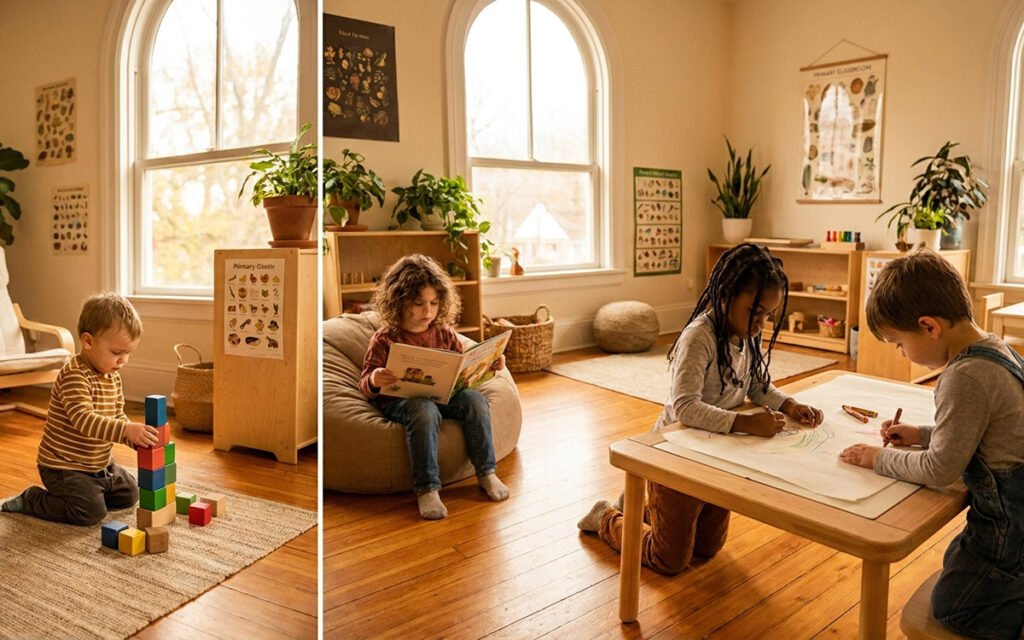
Montessori classrooms typically mix children across a two- to three-year age span, while traditional preschool classrooms are almost always grouped by a single birth year. Neither structure is inherently better for every child. Mixed-age grouping offers built-in mentorship and modeling, while same-age grouping keeps peers at a similar developmental stage for group activities.
Research summarized by Ohio State University’s Schoenbaum Family Center found that mixed-age grouping can support stronger social skills, patience, and language development, since younger children are able to observe older peers and older children build confidence by helping younger ones. In a Montessori classroom, a three-year-old might watch a five-year-old work through a math material and pick up vocabulary and patience just from being nearby.
Same-age grouping in a traditional preschool classroom has its own real advantages. Teachers can plan activities tightly matched to one developmental stage, and children spend the day surrounded by peers working through similar milestones at a similar pace. Families who want their child to be with same-age friends often feel strongly drawn to this format, and that preference is completely reasonable.
The Teacher’s Role: Guide vs. Instructor
In Montessori classrooms, teachers act primarily as guides who observe each child and introduce new materials when a child seems ready, rather than delivering lessons to the whole group at once. Traditional preschool teachers more often lead activities directly, setting the pace and content for the whole class. Both roles require real skill; they’re just built around different assumptions about how children absorb new ideas.
The American Montessori Society’s overview of early childhood program characteristics describes the Montessori teacher’s job as connecting each child to the right material at the right moment, based on careful, ongoing observation. That means less time standing in front of a group and more time crouched beside a single child, watching closely before stepping in.
Montessori and traditional preschool aren’t rivals, they’re different roads to the same goal: a confident, curious child.
Traditional preschool teachers, meanwhile, often excel at building group cohesion through shared songs, stories, and games that give every child a common experience at the same time. That structure can be reassuring for children who like knowing exactly what happens next. You can read more about how KV Montessori Academy trains and supports our guides on our About Us page.
Materials and Hands-On Learning
Montessori classrooms use a specific set of hands-on materials designed to be self-correcting, meaning a child can see and fix their own mistake without a teacher stepping in. A traditional preschool classroom typically offers a broader mix of toys, art supplies, and craft projects that support open-ended play rather than one specific skill.
The Association Montessori Internationale explains that Montessori materials are built with an isolated purpose in mind, like a set of cylinders that only fit correctly one way, so a child receives immediate, private feedback while working. That built-in feedback loop is part of why Montessori classrooms can feel quieter and more focused than a typical playroom.
Traditional preschool classrooms lean into variety instead, rotating through sensory bins, dress-up corners, blocks, and art stations that encourage imaginative and social play. Both approaches build real skills. Montessori materials tend to isolate one concept at a time, while traditional materials often blend several kinds of learning into one open-ended activity.
Pacing and Independence: Self-Paced Days vs. Scheduled Days
Montessori children generally choose their own work and stay with it as long as they need, often called a “work cycle,” while traditional preschool days are usually broken into set blocks of time for specific activities. Montessori pacing follows the individual child, while traditional pacing follows the clock. Both structures can build focus, just through different routes.
Montessori teacher training, described on the Association Montessori Internationale’s site, centers on protecting long, uninterrupted blocks of time so a child can fully absorb a skill before moving on, rather than being pulled away mid-task by a bell or transition. This approach is closely related to what the National Association for the Education of Young Children calls “developmentally appropriate practice,” meaning activities and pacing that match where a child actually is, not just their age on paper.
A scheduled day in a traditional preschool classroom offers a different kind of independence. Children learn to move through transitions, follow a group rhythm, and adapt when an activity ends before they’re finished, which is also a valuable life skill. Neither approach to pacing is right for every child, and many children adapt well to both once they know what to expect.
What Research Says About Montessori vs. Traditional Preschool Outcomes
Research comparing Montessori and traditional preschool outcomes is generally positive toward Montessori but genuinely mixed, and the quality of implementation seems to matter more than the label on the door. A systematic review published in a peer-reviewed journal found some evidence of benefits in areas like executive function and social skills, alongside notable gaps in study quality and consistency across the research.
That review, available through PubMed, noted that well-implemented, authentic Montessori programs tend to show more favorable results than programs that only loosely follow the method. In other words, a genuine, fully trained Montessori classroom and a preschool that borrows a few Montessori materials are not the same thing, even if both use the word “Montessori.”
A Psychology Today summary of the evidence reached a similar, balanced conclusion: some studies point to advantages in independence and social development, while others show no significant difference compared to well-run traditional preschool programs. The honest takeaway is that a caring, well-trained teacher and a thoughtfully run classroom likely matter more than the philosophy printed on the brochure.
A caring teacher and a thoughtfully run classroom often matter more than the label on the door.
How to Choose the Right Fit for Your Child
The best way to choose between Montessori and traditional preschool is to think honestly about your child’s temperament, observe them in an actual classroom setting, and weigh what matters most to your family, rather than assuming one model is universally better. A child who thrives with structure and group routine may love a traditional classroom, while a child who gets absorbed in independent tasks may flourish in a Montessori environment.
HealthyChildren.org’s guidance on choosing child care recommends visiting in person, watching how teachers interact with children, and paying attention to how your child responds to the space before making a decision. No amount of online research replaces watching your child’s face light up, or not, in an actual classroom.
It also helps to think about your priorities as a family: Do you want daily Spanish exposure? A close-knit neighborhood community? A specific approach to reading readiness? Those answers narrow the choice as much as any philosophy does. Our blog offers more first-hand guidance on what a Montessori day actually looks like, especially if you’re still considering your options.
A Brief Closing Thought
Choosing between Montessori and traditional preschool is not about finding the “correct” answer; it’s about finding the classroom where your child feels safe enough to take risks and curious enough to keep trying. Both paths can lead to a confident, capable kindergartner.
Curious what a Montessori day actually looks like for your child? Come see it in person. KV Montessori Academy welcomes families in Eastlake and Chula Vista to tour our classrooms and meet our teachers. Schedule a Tour or call (619) 730-4020.
Every child develops at their own pace, and the information in this article is general educational guidance rather than a guarantee of how any specific child will respond to either model.
Frequently Asked Questions
Is Montessori better than traditional preschool for academic readiness? Not necessarily. Research suggests genuine, well-implemented Montessori programs can support strong academic and executive function skills, but well-run traditional preschool programs also prepare children well for kindergarten. The quality of teaching and the fit for your child’s temperament tend to matter more than the model itself.
Will my child struggle to adjust from a Montessori classroom to a traditional elementary school? Most children adjust without major difficulty, since Montessori builds core skills like focus, problem-solving, and self-direction that transfer to many settings. Some children need a short adjustment period to get used to a more structured, teacher-led schedule, which is normal and typically resolves within the first few weeks. Talking with your child’s new teacher about what to expect can make the transition smoother.
What age should my child start Montessori school? Montessori programs typically welcome children as young as 18 months in toddler classrooms, with additional programs for children ages 2.5 to 6 in Primary and Primary Advanced classrooms. The right starting age depends on your child’s readiness for separation and group settings rather than a strict cutoff. A tour is often the best way to see which program fits your child’s current stage.
Is Montessori preschool more expensive than traditional preschool? Costs vary widely by school, location, and program length, so it’s not accurate to say Montessori is always more expensive than traditional preschool. Some traditional programs cost more due to extended hours or added enrichment classes, while some Montessori programs are comparably priced once you factor in curriculum materials and small class sizes. It’s worth requesting a tuition breakdown directly from any school you’re considering.
Does KV Montessori Academy offer bilingual instruction alongside the Montessori curriculum? Yes, Spanish is woven into daily classroom life at KV Montessori Academy rather than taught as a separate subject, so children absorb a second language alongside their regular Montessori work. This approach is popular with bilingual families in Eastlake and Chula Vista who want dual-language exposure built into an everyday routine. Families can see this firsthand by scheduling a classroom tour.