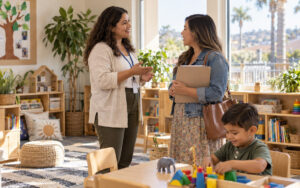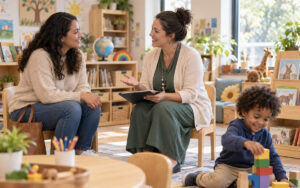
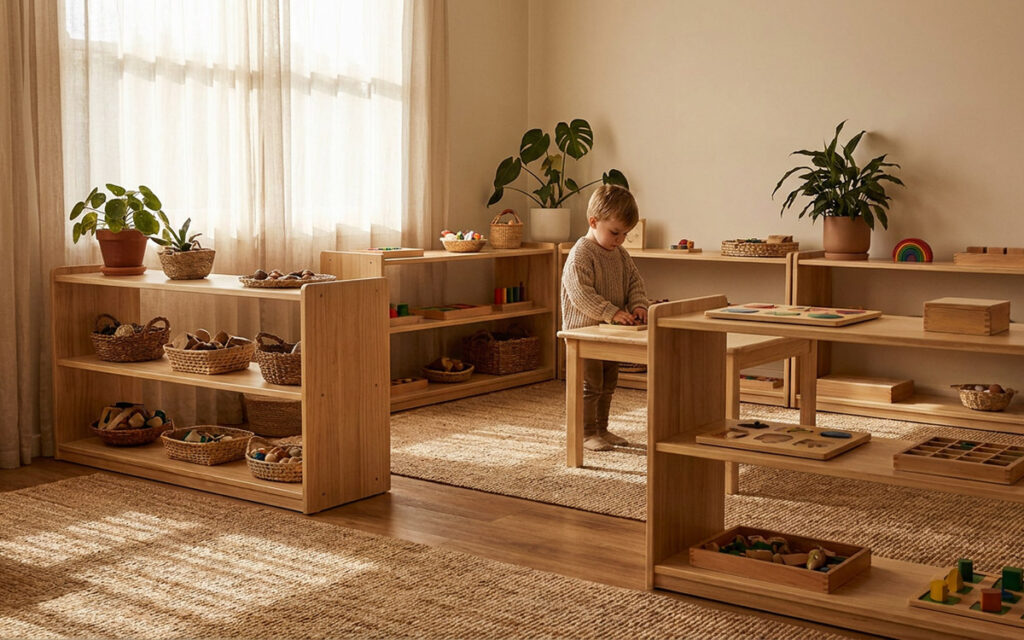
A Montessori prepared environment is a classroom intentionally ordered, made beautiful, and scaled to a child’s size so kids can find, use, and return materials without adult help. Research links this kind of order and predictability to better focus, calmer behavior, and stronger self-regulation in young children. At KV Montessori Academy, both our Toddler and Primary classrooms are designed around this idea every day.
What Is a Montessori Prepared Environment?
A Montessori prepared environment is a classroom set up on purpose around four ideas: order, beauty, accessibility, and child-sized materials. Everything has a logical place, the room is visually calm rather than cluttered, and shelves are low enough that a child can reach, use, and put away materials independently.
This concept sits at the heart of the Montessori method, and the American Montessori Society lists it among the core components that define a genuine Montessori classroom. The Association Montessori Internationale describes these spaces as designed to meet a child exactly where they are developmentally, offering just enough freedom and just enough structure at the same time.
It is worth pausing on why order matters so much at this age. Montessori educators often refer to a “sensitive period for order,” a stretch of early childhood, roughly ages one to four, when children are unusually attuned to routine, sequence, and consistency in their surroundings. A prepared environment is built to work with that natural drive rather than against it.
If you want to see more about how this philosophy shows up across a Montessori day, our blog covers several related topics that parents often ask about.
Why Order and Predictability Help Young Children Feel Calm
Young children have not yet developed the internal tools to manage big feelings on their own, so a predictable, orderly space acts as a kind of external scaffolding for their emotions. When a child already knows where things belong and what happens next, there is less to figure out and less to feel unsettled about.
The Association Montessori Internationale describes this as one of the quieter benefits of a well-prepared classroom: consistent structure provides children a foundation for building self-regulation over time, rather than expecting them to arrive with it already in place. That structure does not have to feel rigid to work. It simply needs to be reliable.
This idea lines up with what pediatric guidance says about routines more broadly. The American Academy of Pediatrics, through HealthyChildren.org, notes that predictable family routines help children feel more secure and behave more calmly, both at home and in group settings like a classroom.
A calm, orderly space does not just look nice. It teaches a child how to think.
Child-Sized Furniture and Accessible Materials Build Independence
Walk into a well-prepared Montessori room and one of the first things you will notice is scale. Tables, chairs, sinks, and shelves are all sized for small bodies, not borrowed from an adult-sized world and shrunk down as an afterthought. That detail matters more than it might seem.
The Montessori Foundation explains that when materials and furnishings are genuinely accessible, children can complete real tasks on their own, from pouring water to choosing a work and putting it away, without waiting for an adult to lift, reach, or fetch something for them. Each small success builds a child’s confidence that they are capable.
This is part of why the physical layout of a classroom is never an afterthought in Montessori education. It is treated as a teaching tool in its own right. You can read more about how this philosophy shapes daily learning on our curriculum page.
How a Calm Classroom Supports Focus and Concentration
A calm, uncluttered classroom helps young children concentrate because it removes competing visual noise, leaving their attention free for the task in front of them. Fewer distractions mean a child can settle into what Montessori educators call the “work cycle,” an extended stretch of self-directed, focused activity, without being pulled away every few minutes.
NAEYC, the National Association for the Education of Young Children, points out that thoughtful classroom design is one of the most effective tools for encouraging positive behavior in preschool-age children, often doing more for focus and cooperation than verbal reminders alone.
This is not about keeping a room bare or sparse. It is about being intentional so that what is out invites concentration instead of overwhelm.
Beauty and Simplicity: Reducing Visual Overwhelm
Montessori classrooms are typically simple and visually calm on purpose, with natural materials, soft colors, and only a handful of activities displayed on each shelf at a time. This is not about aesthetics for their own sake. A simpler visual field is genuinely easier for a young child’s developing brain to process.
Zero to Three, a respected early childhood research organization, explains that adults play a major role in helping young children regulate themselves and that a calm surrounding environment supports that process, described in their resource on co-regulation strategies for infants and toddlers. A child is far more likely to stay regulated in a space that itself feels calm.
Order is not a rule for children. It is simply a form of respect for how they grow.
The Prepared Environment in KV Montessori Academy’s Toddler and Primary Classrooms
This philosophy is not an abstract idea at KV Montessori Academy. It shapes how we think about every classroom, from our Toddler program through our Primary classrooms. Materials are chosen and arranged so children can see their choices clearly, reach what they need, and return it when they are finished.
We also consider order as part of how we support bilingual learning. Labeling, routines, and daily rhythms are designed to feel consistent in both English and Spanish, so a young child’s sense of predictability is not disrupted by moving between languages. It becomes one more layer of the calm, dependable structure a child can count on.
If you would like the fuller picture of our approach and our teachers, our About Us page is a good next stop.
Bringing the Prepared Environment Home
You do not need a Montessori classroom to bring some of this calm and order into your own home. Small, low-effort changes, like a low shelf with a few toys instead of a toy bin overflowing with everything, or a consistent spot for shoes and coats, give a young child the same sense of predictability a prepared classroom offers.
Zero to Three’s guidance on developing self-control between 12 and 24 months notes that consistent routines and a predictable environment are some of the most effective tools parents have for supporting a toddler’s emerging self-regulation. You do not have to overhaul your whole house. Even one or two small, orderly spaces can make a noticeable difference in how settled a child feels.
A Note on Every Child’s Pace
Every child develops on their own timeline, and a calm, prepared environment supports that development without guaranteeing a specific outcome or milestone. This article offers general, educational information to help you understand the thinking behind the Montessori approach.
Bringing It Together
A Montessori prepared environment gives young children something simple but powerful: a space that senses them at their own scale, on their own terms. That order supports calmer behavior, longer focus, and a growing sense of independence, all without a single lecture or worksheet.
Curious what a Montessori day actually looks like for your child? Come see it in person. KV Montessori Academy welcomes families in Eastlake and Chula Vista to tour our classrooms and meet our teachers. Schedule a Tour or call (619) 730-4020.
Frequently Asked Questions
What is a Montessori “prepared environment,” in plain terms?
It is a classroom set up on purpose so a child can use it independently: everything has a place, the room is uncluttered, and furniture and materials are sized for children rather than adults. The goal is that a child can find, use, and put away their own work without needing help for every step.
How does a calm, orderly classroom actually help my child focus?
A calm room has fewer visual distractions competing for a child’s attention, which makes it easier for them to settle into one activity for an extended stretch. Predictability also reduces the mental energy a child spends figuring out what to do next, leaving more of their attention available for actual concentration and learning.
Does a prepared environment mean the classroom has fewer toys or activities?
Not necessarily fewer, but more intentionally displayed. Rather than every toy being available all at once, a prepared environment typically shows a curated selection of activities at any given time, arranged clearly on low, open shelves so a child can see and choose without feeling overwhelmed.
What’s the difference between the Toddler and Primary prepared environments at KV Montessori Academy?
Both programs are built around the same core ideas of order, accessibility, and child-sized materials, but they are adapted to the developmental stage of each age group. Our curriculum page outlines how materials and daily rhythms shift as children move from our Toddler program into our Primary classrooms.
Can I create a “prepared environment” at home if my child isn’t in a Montessori school?
Yes. You do not need special equipment to start. Simple steps like offering a smaller, rotating selection of toys on a low shelf, keeping a consistent spot for daily items like shoes or a backpack, and sticking to predictable routines can bring some of the same calm and independence into your home.