Discover how Montessori education empowers children to think critically, overcome challenges independently, and build lifelong Montessori problem-solving skills.
Problem-solving is one of the most valuable skills children can develop during their early years. Beyond academics, the ability to think critically, evaluate options, adapt to challenges, and find solutions independently influences success in school, relationships, and future careers. While many educational approaches emphasize memorization and following directions, Montessori education intentionally creates opportunities for children to become active thinkers and capable problem-solvers.
Young children are naturally curious. They want to understand how things work, why events happen, and what solutions can address the obstacles they encounter. When educational environments encourage exploration rather than simply providing answers, children learn to trust their own thinking processes and develop confidence in their ability to navigate challenges.
At KV Montessori Academy, we weave Montessori problem-solving skills into every aspect of the learning experience. Through hands-on materials, child-led exploration, practical life activities, and individualized instruction, children are encouraged to think independently and develop the resilience needed to approach challenges with confidence.
“Children become confident problem-solvers when they are given opportunities to discover solutions rather than simply being told the answers.”
These early experiences help build the foundation for critical thinking, adaptability, and lifelong learning.
Montessori Encourages Independent Thinking
One of the hallmarks of Montessori education is its emphasis on independence. Rather than relying solely on teacher-directed instruction, children are encouraged to actively participate in their learning process by making choices, exploring materials, and discovering concepts through experience.
This approach naturally strengthens problem-solving abilities.
In traditional settings, adults may often intervene quickly when a child struggles. While support is important, constantly providing solutions can limit opportunities for children to develop confidence in their own reasoning skills. Montessori teachers take a different approach by guiding children through challenges while allowing them the space to think independently.
For example, if a child encounters difficulty completing an activity, the teacher may ask open-ended questions such as the following:
- “What do you notice about this piece?”
- “What do you think could work differently?”
- “Can you think of another way to try this?”
These prompts encourage reflection rather than dependence.
Children learn that challenges are not obstacles to avoid but opportunities to explore different strategies and approaches. Over time, they become more comfortable navigating uncertainty and trusting their ability to solve problems.
Independent thinking also nurtures creativity. As children experiment with solutions and test ideas, they develop flexible thinking patterns that support innovation and adaptability.
The confidence gained from solving problems independently often extends into social situations, academic pursuits, and everyday decision-making.
Hands-On Materials Promote Critical Thinking
Montessori classrooms utilize carefully designed materials that actively engage children in the learning process. These hands-on tools intentionally support exploration, experimentation, and self-correction.
Unlike worksheets or passive instruction, Montessori materials encourage children to interact physically with concepts.
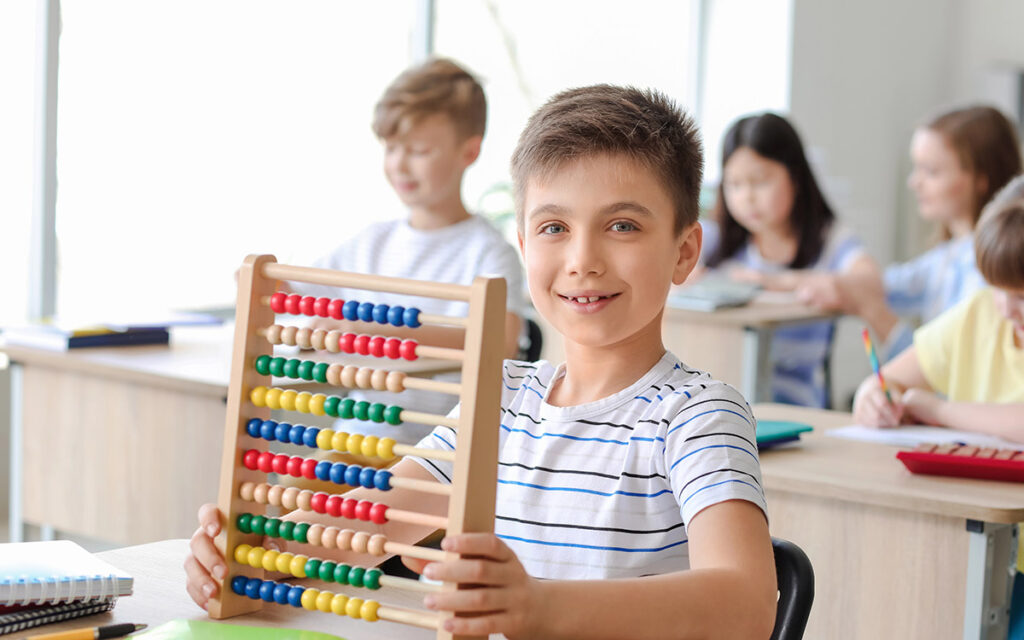
Mathematical materials allow students to manipulate quantities and visualize abstract concepts. Language materials help children connect sounds, symbols, and meaning through tactile experiences. Sensorial activities encourage classification, comparison, and observation.
Many Montessori materials also include a built-in control of error, enabling children to recognize mistakes independently without immediate adult correction.
For instance, if puzzle pieces do not fit together correctly or counting materials reveal an inconsistency, children are prompted to reassess their work and identify solutions on their own.
This process strengthens several important problem-solving skills, including:
- Observation and attention to detail
- Logical reasoning
- Analytical thinking
- Persistence through challenges
- Self-assessment and reflection
Because children experience the satisfaction of identifying and correcting errors independently, they develop resilience and confidence.
Rather than fearing mistakes, they begin to view them as valuable learning opportunities.
This mindset supports lifelong problem-solving by helping children understand that success often involves experimentation, adjustment, and perseverance.
Practical Life Activities Build Real-World Problem-Solving Skills
One of the most distinctive aspects of Montessori education is the emphasis placed on practical life activities. These experiences involve real-world tasks that allow children to develop independence, coordination, and responsibility while strengthening executive functioning skills.
Activities may include:
- Preparing snacks
- Pouring liquids
- Cleaning workspaces
- Organizing materials
- Watering plants
- Folding clothing
- Caring for classroom environments
Although these tasks may appear simple, they require children to engage in numerous problem-solving processes.
Children must sequence steps appropriately, adjust movements when challenges arise, and evaluate outcomes independently. For example, if water spills during pouring practice, they learn how to address the situation rather than relying on adults to fix it.
These experiences help children understand that problems can be managed through thoughtful action and persistence.
Practical life activities also promote planning and decision-making. Children consider what tools they need, determine how to complete tasks efficiently, and evaluate the effectiveness of their efforts.
Because these tasks have meaningful real-world applications, children experience a strong sense of competence and accomplishment.
The problem-solving abilities developed through practical life experiences often transfer into academic learning and daily responsibilities outside the classroom.
Children who regularly practice independent problem-solving become more adaptable and resourceful when encountering new situations.
“Problem-solving skills flourish when children are trusted with meaningful responsibilities and supported in finding their own solutions.”
These early opportunities to navigate challenges independently help build resilience that benefits children throughout their lives.
Montessori Fosters Persistence and Resilience
Problem-solving is rarely about finding immediate answers. More often, it involves persistence, flexibility, and the willingness to try again after setbacks.
Montessori education intentionally cultivates these qualities.
In Montessori classrooms, children work at their own pace and are encouraged to revisit activities until they achieve mastery. There is less emphasis on speed and external rewards and greater focus on effort, concentration, and personal growth.
When children encounter difficulties, they learn that struggle is a normal part of learning rather than evidence of failure.
Teachers support this perspective by modeling patience and encouraging reflection rather than providing instant solutions.
This approach helps children develop resilience.
Resilient children are more likely to:
- Persist when tasks become difficult
- Remain calm during setbacks
- Explore alternative strategies
- Learn from mistakes
- Approach future challenges with confidence
The development of resilience is particularly important in today’s rapidly changing world. Children who can adapt to uncertainty and navigate challenges independently are better equipped to succeed academically and socially.
Montessori environments provide numerous opportunities to practice these skills daily.
As children experience the rewards of persistence, they begin to trust in their ability to overcome obstacles through effort and determination.
This belief becomes an essential component of lifelong problem-solving success.
Collaborative Learning Strengthens Social Problem-Solving
While independent thinking is central to Montessori education, collaboration also plays an important role in developing problem-solving abilities.
Mixed-age classrooms provide opportunities for children to learn from one another, share perspectives, and work together toward common goals.
Through collaborative experiences, children develop social problem-solving skills such as the following:
- Listening to others respectfully
- Communicating ideas clearly
- Negotiating solutions
- Considering different viewpoints
- Resolving conflicts constructively
- Offering and accepting assistance
These interpersonal abilities are critical for success both inside and outside the classroom.
Children learn that some challenges benefit from teamwork and diverse perspectives. They discover that effective problem-solving often involves empathy, cooperation, and open communication.
Teachers guide students through conflict resolution processes that encourage independent thinking while promoting mutual respect.
Rather than solving disputes for children, educators support them in identifying feelings, discussing concerns, and working collaboratively toward solutions.
These experiences strengthen emotional intelligence alongside critical thinking skills.
By balancing independent exploration with cooperative learning, Montessori education helps children become well-rounded problem-solvers who can navigate both individual and group challenges effectively.
Frequently Asked Questions
Why are problem-solving skills important in early childhood?
Problem-solving skills help children develop critical thinking, resilience, decision-making abilities, and confidence when facing challenges in academics and everyday life.
How does Montessori encourage problem-solving?
Montessori classrooms use hands-on materials, practical life activities, child-led learning, and teacher guidance that promotes independent thinking and exploration.
What are Montessori control of error materials?
These are materials designed to allow children to identify and correct mistakes independently, encouraging self-assessment and persistence.
Do Montessori teachers provide help when children struggle?
Yes. Montessori teachers guide and support children through open-ended questions and observation while encouraging them to discover solutions independently.
How do problem-solving skills benefit children long-term?
Strong problem-solving abilities support academic achievement, emotional resilience, adaptability, collaboration, and future success in many areas of life.
Helping children become capable problem-solvers is one of the greatest gifts education can provide. When children learn to think critically, approach challenges with confidence, and persist through difficulties, they develop skills that support lifelong success.
At KV Montessori Academy, children explore, question, and discover solutions through authentic Montessori experiences that nurture independence and resilience. By empowering students to become thoughtful problem-solvers from an early age, the school helps prepare them for future academic achievements and life’s many opportunities.
Ready to see Montessori problem-solving in action? Schedule a Tour at KV Montessori Academy to discover how our child-centered approach helps children build confidence, critical thinking skills, and a lifelong love of learning.