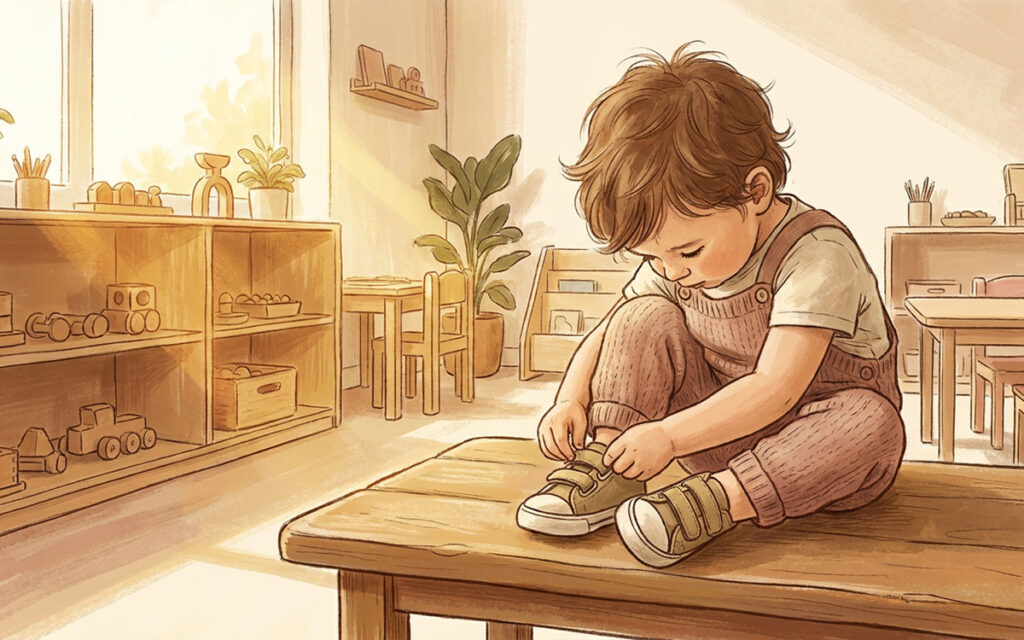
Early childhood independence is not just about tying shoes or pouring water. Skills like self-regulation, focus, and problem-solving that toddlers build through everyday “I can do it myself” moments are the same skills researchers connect to later school success. At KV Montessori Academy in Eastlake, this growth is intentional, starting in the Toddler program and building steadily through Primary.
What Does Early Childhood Independence Really Mean?
Independence for a toddler is not the absence of supervision. It means a child has both the physical capability and the real opportunity to do a task on their own, from pouring milk to zipping a jacket, while a prepared, watchful adult remains nearby. The American Montessori Society describes infant and toddler classrooms as designed specifically to hand children this kind of safe, guided autonomy.
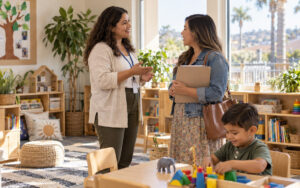
Picture a low shelf with a small pitcher sized for little hands or a child-height hook for a jacket. Nothing about the room asks a toddler to wait for an adult to do it for them. That physical setup, often called the “prepared environment” in Montessori language, simply means a space arranged so children can act on their own within safe limits.
At KV Montessori Academy, the environment looks like real classroom furniture built to a toddler’s scale, not adult furniture with a step stool pushed up to it. You can see how this concept plays out across age groups on our Toddler and Primary curriculum pages.
The Science Behind Early Childhood Independence and Executive Function
Every time a toddler chooses a task, sticks with it, and finishes it, they are practicing executive function, the mental skill set that includes focus, impulse control, and planning. Researchers at NAEYC describe these skills as some of the strongest early predictors of how well a child will manage school later on.
Executive function is not something children are simply born with in finished form. It develops through repeated, low-stakes practice, and NAEYC’s research on self-regulation points to daily routines, choices, and even minor frustrations (a stuck zipper, a spilled cup) as the training ground.
That reframes the small, sometimes slow moments of a toddler’s day. A child struggling to snap their coat isn’t wasting time. They are building the same mental muscles they will later use to sit through a lesson or finish a worksheet.
A toddler pouring their own water isn’t just a chore. It’s the beginning of focus, patience, and confidence.
The Toddler Program: Where Independence Starts
Between 18 and 36 months, children are wired to want to do things themselves, even when it takes three times as long. Zero to Three’s research on this age range notes that toddlers are actively developing new physical and problem-solving skills through everyday play and routines, not just structured lessons.
Just before this stage, from about 12 to 24 months, children are also learning early self-control, a process Zero to Three describes as gradual and closely tied to a secure relationship with a caregiver. Self-control does not arrive all at once. It grows through consistent routines and an adult who stays calm when things get messy.
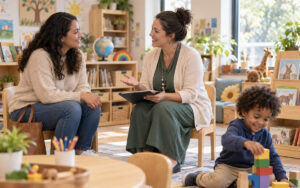
In KV Montessori Academy’s Toddler classroom, this translates into predictable daily rhythms: hanging up a jacket at the same hook every morning, washing hands before snack, and choosing between two simple activities. These small, repeated choices are exactly what toddlers this age are developmentally ready for.
Practical Life Work: The Hidden Curriculum of Independence
Practical life activities, like pouring, spooning, buttoning, and food preparation, are often the first work a child does in a Montessori classroom, and they matter more than they look. These simple, real tasks build coordination, concentration, and independence during what Montessori educators call a “sensitive period,” a stretch of early childhood when a child is especially drawn to mastering a particular skill.
The AMI glossary of Montessori terms explains that sensitive periods are temporary windows of intense focus and motivation. A toddler fascinated by buttons or a preschooler who wants to sweep the same spot ten times in a row is not being fussy. They are working through exactly the kind of repetition their developing brain is asking for.
Because these tasks use real, breakable objects (glass pitchers, not plastic toys), children also learn natural consequences and careful movement. It is ordinary work, done with unusual seriousness, and that seriousness is the point.
From Toddler to Primary: Independence as a Continuum
Independence at KV Montessori Academy does not reset each time a child moves to a new classroom. The American Montessori Society’s five core components (which include multi-age classrooms, trained guides, and student choice within structure) are designed so a skill practiced as a toddler carries forward and deepens in Primary.
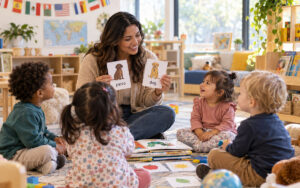
Mixed-age classrooms play a real role here. A three-year-old sees a five-year-old confidently managing their materials and naturally wants to try it too, while the older child reinforces their independence by helping a younger classmate. Our curriculum page outlines how Toddler, Primary, and Primary Advanced classrooms build on one another rather than functioning as separate, disconnected years.
By the time a child reaches Primary Advanced, tasks that once felt like a triumph (pouring water, setting a placemat) have become second nature, freeing attention for more complex academic and social work.
What Does Research Say About Long-Term Outcomes?
A longitudinal study following children in Montessori classrooms found that early exposure was associated with stronger academic and social-emotional measures years later, including in areas like executive function and a sense of community. This kind of research, summarized in a peer-reviewed study published via the National Institutes of Health, points to a meaningful association rather than a guarantee for any individual child.
It is worth being honest about what research like this can and cannot say. Correlational studies like this one identify patterns across many children, not a promise about what will happen for yours. Every child develops on their own timeline, shaped by temperament, environment, and everyday experience.
Still, the pattern is consistent enough to matter: environments that hand children real, age-appropriate independence tend to see stronger outcomes in self-regulation and problem-solving down the road.
How Parents Can Support Early Childhood Independence at Home
You can build the same habits KV Montessori Academy practices in the classroom right at your kitchen table. Offer two acceptable choices instead of open-ended ones (“blue shirt or green shirt?”), build in extra time so a child can finish a task without rushing, and expect some mess along the way.
The American Academy of Pediatrics, via HealthyChildren.org, recommends praising effort and persistence rather than a perfect result. A wobbly, spilled attempt at pouring cereal deserves more encouragement than a parent quietly redoing it once the child walks away.
PULL QUOTE: Independence grows fastest when adults offer real choices, extra time, and patience with the mess.
Small routines at home, like letting a toddler carry their own lunch bag or choose between two snack options, reinforce exactly what happens during the school day. Consistency between home and classroom is one of the simplest ways to support this growth.
The Takeaway
Early childhood independence is built one ordinary moment at a time, through pouring, buttoning, choosing, and trying again. At KV Montessori Academy, that growth is woven into daily classroom life from Toddler through Primary, supported by a prepared environment and teachers who know when to step back.
Every child develops at their pace, and the ideas in this article are general educational information rather than a promise of specific outcomes for any individual child.
Curious what a Montessori day actually looks like for your child? Come see it in person. KV Montessori Academy welcomes families in Eastlake and Chula Vista to tour our classrooms and meet our teachers. Learn more about our approach on our About Us page, or Schedule a Tour today, or call (619) 730-4020.
Frequently Asked Questions
At what age should I start encouraging independence in my toddler?
Many families notice their child’s drive toward independence emerging between 12 and 24 months, and it becomes especially strong between 18 and 36 months. You do not need to wait for a certain age. Start with small, safe tasks like putting a toy away or choosing between two snacks, and let your child’s interest guide the pace.
Does more independence at home mean less structure or fewer rules?
No, independence actually works best within clear, consistent limits. Offering a child two acceptable choices, rather than unlimited options, provides them real decision-making power while keeping routines predictable. Structure and independence work together, not against each other.
How does KV Montessori Academy’s Toddler program support independence?
Our Toddler classroom uses child-sized furniture, predictable daily routines, and simple practical life activities like pouring and hand washing so children can act independently within a safe, prepared space. You can find more detail on our curriculum page.
Is Montessori independence the same as letting a child do whatever they want?
Not at all. Montessori independence is guided freedom within limits set by a trained teacher, not an absence of guidance. Children choose from a set of appropriate activities and are supported by an adult who steps in when needed.
What if my child resists doing things independently?
That is completely normal and does not mean something is wrong. Every child develops self-reliance at their own pace, and gentle, low-pressure opportunities to try (without forcing it) tend to work better than pushing. A KV Montessori Academy teacher can also share specific strategies that fit your child’s temperament during a tour or conversation.