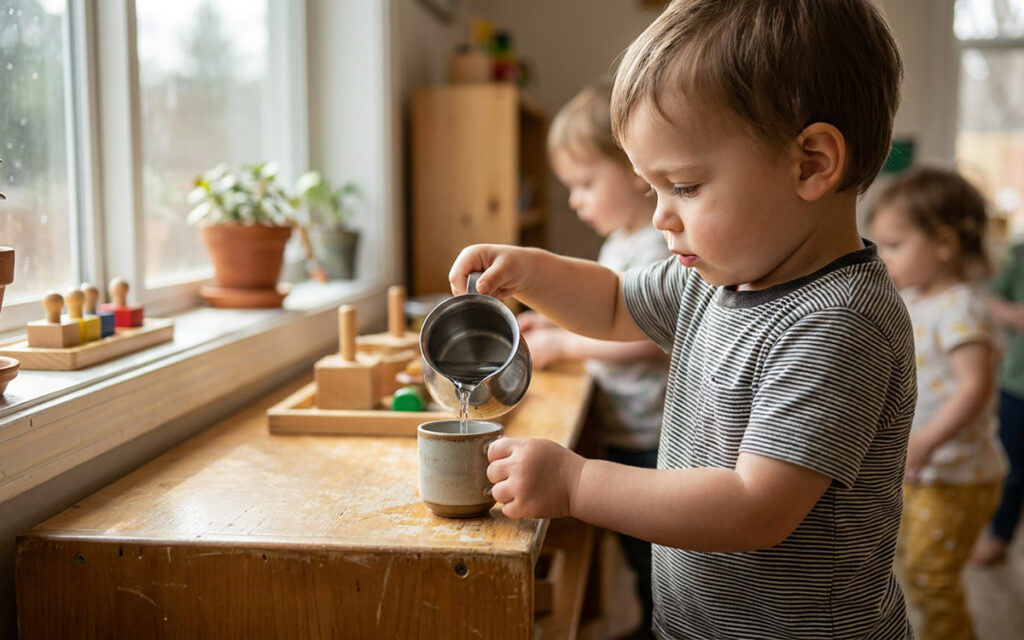
Montessori classroom confidence isn’t handed out through praise. It’s built through real skills. Children ages 2 to 6 pour their water, fix their mistakes using self-correcting materials, and choose their own work. Each small success gives a child proof, not just a compliment, and that proof is what makes their confidence last.
Every parent touring a preschool wants to know the same thing: will my child feel capable here? It’s a fair question, and it gets at something deeper than good behavior or a happy drop-off. Real Montessori classroom confidence comes from a specific design choice built into the materials themselves, one that lets children discover their competence without waiting for an adult to tell them they did well. That distinction matters more than most parents realize when they’re comparing programs.
What Real Confidence Looks Like in a 2 to 6 Year Old
Confidence in early childhood isn’t a feeling a child is born with or without. Developmental researchers distinguish between self-esteem (how a child feels about themselves in general) and self-efficacy (a child’s belief that they can actually accomplish a specific task). NAEYC’s research on mastery motivation describes this second kind as something children build through direct, repeated experience with real challenges, not through being told they’re smart or capable.
A three-year-old who has learned to pour her juice without spilling doesn’t just feel competent She knows, from evidence, that she can do it again tomorrow. That’s the version of confidence a Montessori classroom is designed to grow.
Why Praise Alone Doesn’t Build Lasting Confidence
Praise feels good in the moment, but it doesn’t always translate into a child’s belief in their ability. The American Academy of Pediatrics notes that a child’s sense of self grows more from mastering real skills and facing appropriate challenges than from hearing “good job” repeated throughout the day. Praise tied to the person (“you’re so smart”) tends to be less durable than confidence built from watching a task actually work.
This doesn’t mean Montessori teachers never encourage children. It means the classroom is set up so children get feedback from the materials and the task itself, not only from an adult’s reaction. A child who lines up the pink tower blocks and watches one wobble and fall knows immediately, without anyone saying a word, that something needs adjusting.
Self-Correcting Materials: How Children Learn to Catch Their Own Mistakes
This is the piece that sets a Montessori classroom apart from most traditional preschool settings. Nearly every Montessori material is designed with what’s called “control of error,” meaning the material itself shows the child when something is wrong, without a teacher stepping in to correct or grade the work. According to the American Montessori Society, this built-in feedback lets children work through mistakes independently and repeat a task until it feels right to them.
Think of the knobbed cylinder blocks in a Primary classroom. If a child places a cylinder in the wrong hole, there’s a visible gap or a piece left over. No one has to point it out. The child sees it, tries again, and solves it in their own way and at their pace.
A child who catches her mistake doesn’t need anyone to tell her she got it right.
That small, private loop of noticing a problem and fixing it, over and over, is where a lot of real classroom confidence actually comes from. It happens quietly, without an audience, which is part of why it sticks.
Mastery Motivation: Why Repetition Matters More Than Speed
A child who repeats the same puzzle map or pouring exercise ten times in a week isn’t stuck or behind. She’s building mastery motivation, the internal drive to keep working at something until it’s truly understood, not just finished. Montessori environments are built around uninterrupted stretches of work time specifically so children can repeat a task as many times as they need, according to guidance from the Association Montessori Internationale on how these environments are structured.
In a traditional classroom schedule, activities often move on a fixed timer. In a Montessori Primary classroom, a child can return to the same geography puzzle five days in a row until the satisfaction of doing it smoothly becomes its own reward. That repetition, not speed, is what turns a skill into confidence.
Independence Within a Prepared Environment
Independence plays a supporting role in this picture, though it’s not the whole story. Montessori classrooms are set up as a “prepared environment,” meaning child-sized furniture, low shelves, and accessible materials so children can choose and complete work without constantly asking an adult for help, a design principle described in AMI’s overview of Montessori environments. Freedom within clear limits gives children room to attempt tasks and make choices, which supports the confidence built through the self-correcting materials themselves.
We’ve written more specifically about how Montessori builds independence in young learners if you want to explore that aspect further.
Practical Life Activities That Build Real Competence
Practical life activities, the everyday tasks of pouring, buttoning, spooning, and sweeping, might look simple, but they’re carefully chosen because they give a young child a complete, visible task with a clear beginning and end. The American Montessori Society points to these hands-on activities as some of the earliest and most powerful ways preschool-age children experience real competence, rather than just performing competence.
In our Primary classroom, a child might spend fifteen minutes washing a table: wetting the sponge, scrubbing in circles, drying it, and putting the supplies away exactly where they found them. It’s not a chore dressed up as learning. It’s a real task with a real, visible result that the child produced entirely by herself.
A Day Inside KV Montessori Academy’s Bilingual Primary Classroom
At KV Montessori Academy, this experience plays out daily in our Primary and Primary Advanced classrooms in Eastlake, where children work alongside self-correcting materials during long, uninterrupted work cycles in both English and Spanish. A child might practice pouring in the practical life area in the morning, then return to it again after lunch, simply because they don’t feel mastery at it yet. Our curriculum page explains how we structure these work periods for children ages 2 through 6.
Families often tell us the shift is visible within a few months: a child who used to ask “is their work right?” starts quietly checking their own work instead. You can read more about our approach and teaching team on our About Us page.
Every child moves through these stages at their own pace, and this article is meant as general educational information about the Montessori method rather than a promise of specific results for any individual child.
Curious what a Montessori day actually looks like for your child? Come see it in person. KV Montessori Academy welcomes families in Eastlake and Chula Vista to tour our classrooms and meet our teachers. Schedule a Tour or call (619) 730-4020.
Frequently Asked Questions
At what age do children start building independence in a Montessori classroom?
Children typically begin practicing independent tasks as toddlers, around 18 months to 2 years, with simple activities like pouring or putting away their own belongings. By the Primary years (ages 3 to 6), that independence expands into choosing and completing multi-step work on their own. The pace varies by child, but the environment is designed to invite independence from the earliest stages.
Isn’t praise still important for kids? Won’t cutting back on it hurt their confidence?
Praise still has a place, especially warm, specific encouragement about effort. The difference in a Montessori classroom is that praise isn’t the main source of a child’s confidence. Because materials are self-correcting, children receive direct feedback from the task itself, which builds a steadier kind of confidence than praise alone can provide.
What does “control of error” actually mean?
Control of error is a Montessori design principle where a material shows the child directly whether a task was done correctly, without needing a teacher to check it. For example, if puzzle pieces don’t fit or a stack of blocks wobbles, the child sees the problem and can try again on their own. It’s a core reason Montessori materials support self-directed learning.
How is a bilingual Montessori classroom different from a regular bilingual preschool?
In a bilingual Montessori classroom like ours, Spanish and English are woven into the daily work cycle itself, not taught as separate subjects at separate times. Children hear and use both languages while working with practical life and sensorial materials, which pairs language learning with the same hands-on, self-paced approach that builds classroom confidence.
How can I tell if Montessori is a good fit for my child?
The best way is to observe a classroom in session and see how children interact with the materials and each other. Montessori tends to suit children well when they’re given time to work through tasks at their own pace, though every child adjusts differently. A tour is the most reliable way to get a feel for whether the environment fits your child.